
Options Trading Journal India: What Every F&O Trader Should Track
MyTradeDiary Editorial Team · Published 18 September 2026 · Updated 18 September 2026 · 12–15 min read

A ₹10,000 profit doesn't always mean you traded well.
And a ₹3,000 loss doesn't always mean you traded badly.
This becomes especially important in options trading.
Imagine two trades. In the first, you followed your setup, selected the strike you had planned, kept your position size under control and respected your stop-loss. The trade lost ₹3,000.
In the second, you entered late, doubled your quantity after the premium moved against you, ignored your stop-loss and eventually exited with a ₹10,000 profit because the market reversed.
Which was the better trade? Your P&L screen says the second one. Your trading process may say the first one.
This is exactly why an options trader needs more than a broker tradebook. A proper options trading journal records not just the contract, but also the strategy, strike selection, entry logic, market conditions, execution, mistakes and emotions surrounding it.
For Indian traders dealing with NIFTY, BANKNIFTY, stock options and other F&O instruments, that context can be far more useful than simply looking at daily profit and loss. This guide explains what to journal and how to turn those records into something useful.
In this guide
- Why Options Trading Needs a Different Journal
- What to Record in Every Options Trade
- Journal Example
- Strike Selection
- Option Buying vs Option Selling
- Strategy Tracking
- Entry and Exit Reasons
- Psychology and Emotions
- Revenge Trading
- Overtrading
- Time-of-Day Analysis
- Good Trade vs Profitable Trade
- Weekly Review
- Excel vs Options Journal App
- MyTradeDiary
- FAQ
Why Options Trading Needs a Different Kind of Journal
A normal equity trade can sometimes be described with buy price, sell price, quantity and profit or loss. Options trades often need more context.
Two NIFTY trades can have completely different outcomes even when the trader has the same market direction in mind. Strike selection, expiry, premium paid or received, position size, timing and whether you were buying or selling options all matter. Multi-leg strategies add another layer because individual orders belong to one trading idea.
A broker tradebook records transactions. An options journal records decisions.
Your journal should answer: “Why did this particular options trade behave the way it did, and did I execute it according to my plan?” It does not need fifty variables. Capture enough information to find useful patterns later.
What Should You Record in Every Options Trade?
Start with information you will realistically use later. If entering a journal becomes more difficult than placing the actual trade, you probably won't maintain it consistently.
1. Underlying Instrument
Record NIFTY, BANKNIFTY, FINNIFTY or the stock itself—such as RELIANCE, HDFCBANK or INFY—rather than simply writing ‘options’.
2. Strike Price
Record the exact strike. NIFTY 25000 CE is more useful than NIFTY Call.
3. CE or PE
Clearly identify Call Option or Put Option with a consistent tag.
4. Expiry
Store the actual contract expiry date. Avoid assumptions based on expiry schedules, which can change.
5. Entry and Exit Premium
Buyer: ₹142 entry, ₹178 exit. Seller: sold at ₹210, bought back at ₹124.
6. Quantity or Lots
Actual position size helps distinguish execution quality from increased exposure.
7. Entry and Exit Time
Timing is especially useful when reviewing intraday decision-making.
8. Stop-Loss
Record both the planned stop and actual exit to reveal moved or ignored stops.
9. Trading Strategy
Use consistent names for option buying, selling, spreads, straddles, strangles, iron condors, butterflies, calendars and hedges.
10. Entry Reason
Keep it short: ‘Price broke resistance after consolidation and I entered after confirmation.’
11. Exit Reason
Was it a target, stop, time-based exit, invalidation, market change, panic or manual profit booking?
12. Emotion
Record the closest state: calm, confident, hesitant, FOMO, fearful, frustrated, revenge mindset or overconfident.
13. Mistake
Tag late entries, chased premiums, oversizing, moved stops, averaging, revenge trades, no setup, overtrading or early exits.
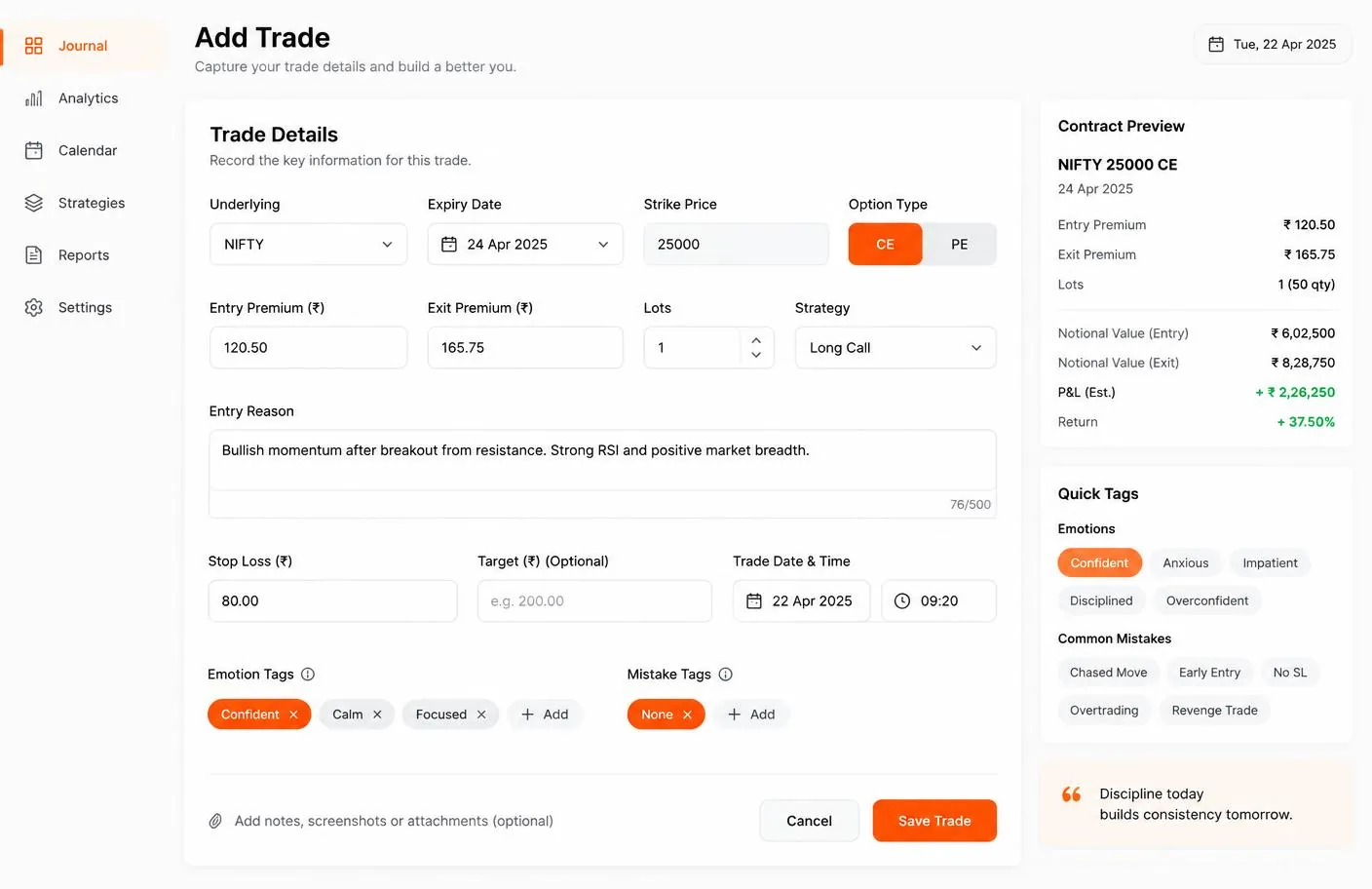
A Practical Options Trading Journal Example
NIFTY 25000 CE · Option Buy
- Strategy
- Breakout
- Entry / Exit Premium
- ₹142 / ₹178
- Quantity
- 150
- Planned Stop
- ₹120 premium
- Entry Reason
- Price broke intraday resistance after consolidation with broader market strength.
- Exit Reason
- Partial target achieved and momentum weakened.
- Emotion
- Calm before entry · Anxious during trade
- Mistake
- Booked part of the position earlier than planned.
- Lesson
- The setup worked, but exit rules need to be more clearly defined before entry.
Notice how much more useful this becomes than simply recording “NIFTY Options — Profit: +₹5,400.” The P&L tells you what the trade produced. The journal gives you something to review.
Track Strike Selection — Not Just P&L
A common mistake is recording the strike but never reviewing strike selection as a behaviour. You may repeatedly choose contracts because the premium appears inexpensive rather than because the strike matches your plan.
The objective is not to prove that ATM, ITM or OTM options are universally better. It is to discover whether your process is consistent and whether certain choices repeatedly create problems for your own trading style.
Illustrative strike analysis — sample data
ATM Trades
32 trades
+₹620 average
OTM Trades
27 trades
-₹480 average
ITM Trades
14 trades
+₹310 average
These are fictional numbers used only to demonstrate how journal analysis can work.
Option Buyers and Option Sellers Should Review Different Questions
If You Buy Options
- Why did I expect the premium to move?
- Was my directional view clear?
- Did I chase after the move started?
- Was position size appropriate?
- Did I hold a losing premium hoping for recovery?
- Did I exit according to plan?
- Did I buy because the premium looked cheap?
If You Sell Options
- Why did I sell premium?
- Was risk defined before entry?
- Was the position hedged if the strategy required it?
- Did I understand the maximum planned loss?
- Did I increase exposure after adversity?
- Was the exit based on a rule or hope?
- Did a high historical win rate encourage excessive risk?
Buying and selling options can create different behavioural problems. Your journal should reflect the way you actually trade.
Track Options Strategies as Complete Trades
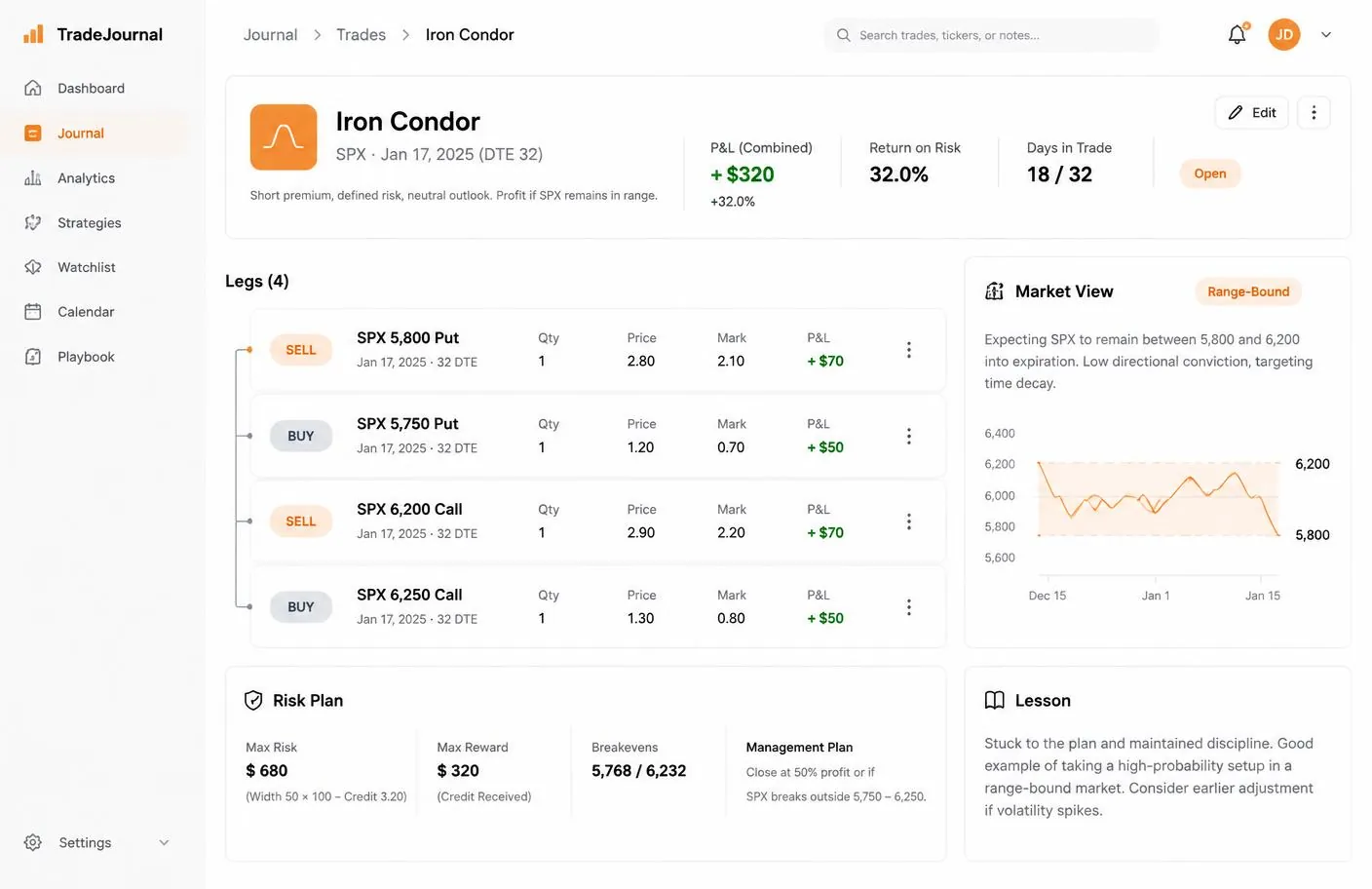
Multi-leg strategies can become confusing when every order is reviewed separately. An iron condor may contain several buys and sells, but those legs represent one idea.
Iron Condor · NIFTY
- Market View
- Range-bound
- Entry Reason
- Expected price to remain within the planned range
- Risk Plan
- Defined before entry
- Adjustment
- None
- Final Result
- Combined strategy result
- Lesson
- What worked or failed at strategy level
Review the trading idea, not just the individual orders.
Your Entry and Exit Reasons May Matter More Than the Contract
You may initially group 100 trades by NIFTY, BANKNIFTY, CE and PE. Another classification may reveal more: planned setup, FOMO, breakout, reversal, random entry, revenge trade or news reaction.
Trade A
NIFTY CE entered after planned confirmation.
Trade B
NIFTY CE entered after the premium jumped because you feared missing the move.
The contracts may be similar. The decisions were not. Exit tags can be equally revealing.
If planned exits perform reasonably while panic exits repeatedly cut strong ideas short, that is a behavioural pattern worth investigating. The aim is not to make every exit rigid, but to understand what drives your decisions.
Options Trading Psychology Belongs in the Journal
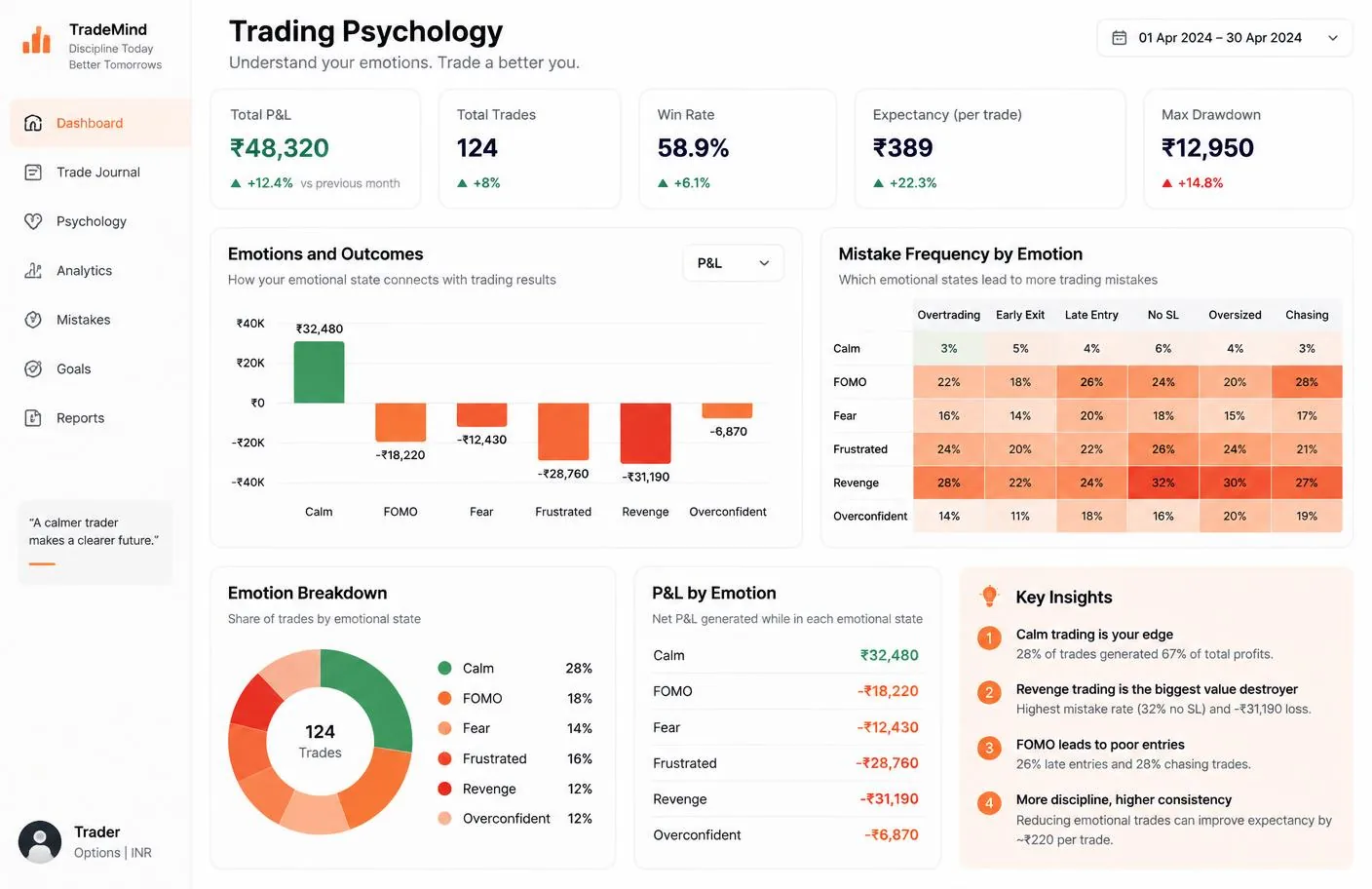
Options can make emotional mistakes feel urgent. Premiums can move quickly, and a small move in the underlying can make the position look dramatically different within minutes. That can encourage chasing, averaging, oversizing, early exits and immediate re-entry after a loss.
Example only
26
Calm trades
11
FOMO trades
8
Revenge trades
The important question is not which emotion appears most often. It is whether a particular state repeatedly changes how you execute your plan.
Revenge Trading Is Easier to See in a Timeline
9:42 AM
Planned NIFTY trade
+₹2,100
10:26 AM
Planned BANKNIFTY trade
-₹1,800
11:18 AM
Another planned trade
-₹2,400
11:24 AM
Immediate re-entry
No clear setup
11:31 AM
Quantity increased
11:39 AM
Another entry after loss
12:02 PM
Large daily drawdown
If you only look at final daily P&L, these become one number. A journal preserves the sequence and shows that behaviour changed after the losses—not necessarily that the entire strategy stopped working.
An Options Journal Can Expose Overtrading
Overtrading is difficult to identify from memory. Review performance by trade number instead.
Example data
This does not mean every trader should stop after three trades. It means this hypothetical trader has found something worth testing: selectivity, frustration, boredom, fatigue, revenge trading or lower-quality setups later in the session.
Analyse Your Trading by Time of Day
Intraday options traders should consider recording entry time—not because there is one universally perfect time, but to find their own patterns.
| Time window | Trades | Sample result |
|---|---|---|
| 9:15–10:00 | 18 | +₹8,400 |
| 10:00–11:30 | 24 | +₹3,200 |
| 11:30–1:30 | 17 | -₹1,900 |
| 1:30–3:00 | 21 | -₹6,200 |
| 3:00–Close | 8 | +₹600 |
Illustrative example — not real MyTradeDiary user data.
A Profitable Trade Can Still Be a Badly Executed Trade
Good process
- NIFTY option trade
- Setup followed
- Position size within plan
- Stop respected
- Exit according to rule
- Result: -₹2,500
Poor process
- NIFTY option trade
- Random entry
- Position oversized
- Stop ignored
- Averaged after loss
- Market eventually reversed
- Result: +₹9,000
If you judge yourself only by P&L, the second trade receives praise. That can reinforce dangerous behaviour. A journal lets you evaluate financial outcome and execution quality separately.
Did I follow my trading plan?
Screenshots Can Make an Options Journal Much More Useful
Numbers do not always show the full context. Save the chart at entry and exit, important support or resistance, the setup, contract details and a short note explaining the decision.
But avoid a folder of hundreds of screenshots without context. Attach each image to its journal entry as an entry screenshot, exit screenshot or post-trade note so the visual record remains searchable.
What Should You Review at the End of the Trading Day?
- Did I follow my planned setups?
- Which trade was best executed?
- Which trade was worst executed?
- Did I break my position-size rules?
- Did I move or ignore a stop?
- Did a loss change my behaviour?
- Did I take a FOMO trade?
- Did I overtrade?
- Was my exit planned or emotional?
- What is one thing I should avoid repeating tomorrow?
This review should take minutes, not hours. The objective is consistency.
What Should You Review Every Week?
Daily reviews capture detail. Weekly reviews reveal patterns.
Best Setup
Which setup produced your strongest results?
Worst Setup
Which setup repeatedly underperformed?
Most Common Mistake
What mistake appeared most often?
Emotional Pattern
Which emotion was associated with rule-breaking?
Overtrading
Did performance change as trade count increased?
Plan Adherence
How many trades followed your rules?
“This week I will not take another trade immediately after two consecutive losses.”
One specific rule is easier to test than “I will become more disciplined.”
Monthly Options Trading Review
At month-end, compare underlying, strategy, CE versus PE, buying versus selling, strike classification, day, time, position size, mistakes, emotions and plan adherence.
Historical journal data describes what happened. It does not predict future market performance or guarantee future results.
Excel vs a Dedicated Options Trading Journal
There is nothing wrong with using Excel. A spreadsheet is often an excellent way to start because you control its columns, formulas and structure.
| Feature | Excel / Sheets | Options journal app |
|---|---|---|
| Basic trade entry | Yes | Yes |
| Strike / expiry fields | Can be created | Built-in if supported |
| Strategy tags | Manual | Easier |
| Emotion tracking | Manual | Easier |
| Mistake tracking | Manual | Easier |
| Trade screenshots | Possible | More organized |
| Filtering | Yes | Usually easier |
| Performance charts | Must be configured | Can be automatic |
| Behaviour analysis | Manual | Easier |
| Large trade history | Can become cumbersome | Easier to organize |
As history grows, screenshots can end up elsewhere, names become inconsistent and notes get buried. A dedicated journal can reduce that administration—but the tool itself is not what creates value. The quality of your review does.
Not sure whether you need an app yet? Read our complete Trading Journal India guide.
How MyTradeDiary Helps Options Traders Review Their Behaviour
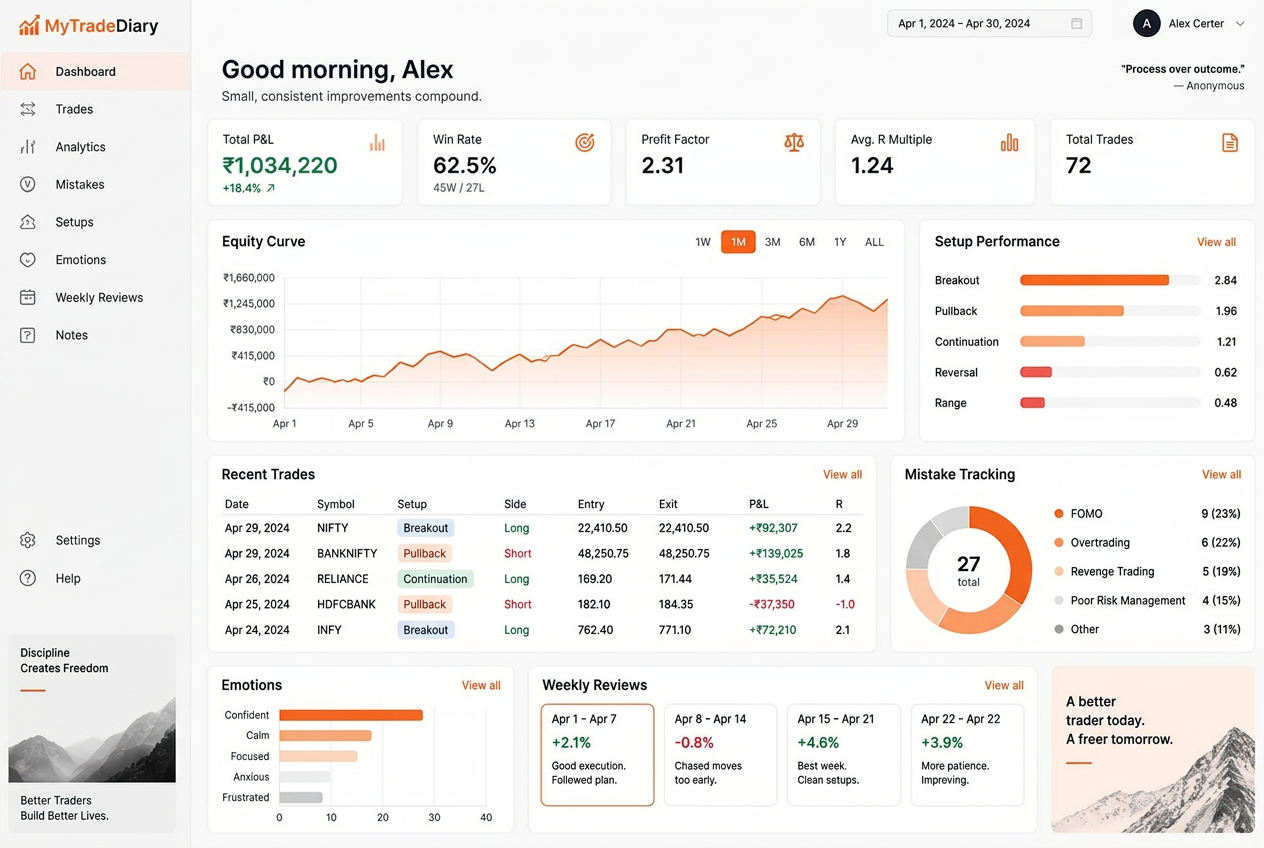
This is one reason we built MyTradeDiary. A journal should help you see more than final P&L. Traders can keep trade details, setups, mistakes, emotions, daily notes, performance history and discipline reviews together.
Trade Journal
Keep trade information together.
Setup Tracking
Tag the reason behind each trade.
Mistake Tracking
See which errors repeat.
Emotion Tracking
Understand behaviour around decisions.
Performance Review
Review historical patterns.
AI Summary
Summarize activity and highlight areas worth reviewing.
The goal is simple: instead of remembering how you think you traded, review how you actually traded. AI-assisted summaries organize historical notes; they do not predict markets or recommend trades.
Review More Than Your P&L
Keep your trades, setups, mistakes, emotions and reviews together with MyTradeDiary.
How to Start an Options Trading Journal Today
Do not start by building the perfect journal. Start with your next options trade.
- What did I trade?
- Why did I choose this contract?
- Why did I enter?
- Where was I wrong?
- How much risk did I plan?
- How did I exit?
- Did I follow the plan?
- What emotion affected me?
- What mistake did I make?
- What did I learn?
After 20 trades, review your notes. After 50, group them by setup and mistake. After 100, you will have something a broker P&L screen cannot provide: a record of your own decision-making.
The purpose of the journal is not to predict tomorrow's market. It is to make yesterday's behaviour easier to understand.
Frequently Asked Questions About Options Trading Journals
What is an options trading journal?
An options trading journal is a structured record of options trades together with information such as the underlying instrument, strike price, expiry, entry and exit premium, strategy, position size, reason for entry, mistakes, emotions and post-trade observations.
What should I record in an options trading journal?
At minimum, consider recording the underlying, strike, CE or PE, expiry, entry price, exit price, quantity, strategy, entry reason, stop-loss, result and a short post-trade note. Traders may also find mistake and emotion tracking useful.
Is an options trading journal useful for NIFTY traders?
Yes. A journal can help NIFTY options traders organize trades by strategy, strike selection, entry timing, mistakes, emotions and execution quality instead of reviewing only their final profit or loss.
Can I use Excel as an options trading journal?
Yes. Excel or Google Sheets can work well, especially when you are starting. A dedicated journal becomes useful when you want easier filtering, strategy tagging, mistake tracking, emotion tracking and automated performance views.
Should option buyers and option sellers journal differently?
The basic structure can be similar, but the questions may differ. Option buyers may focus more on entry timing, premium paid and chasing moves, while sellers may focus more on risk definition, position sizing, strategy structure and exit discipline.
Should I record emotions in my trading journal?
It can be useful. Simple emotion tags such as calm, FOMO, frustrated or revenge mindset can help you review whether certain emotional states repeatedly coincide with changes in your trading behaviour.
Can a trading journal prevent losses?
No. A trading journal cannot prevent losses or guarantee profitability. It is a review tool designed to help traders examine their historical decisions, behaviour and execution.
How often should an options trader review a journal?
A short review after the trading day, a more detailed weekly review and a broader monthly review can provide different perspectives. The ideal frequency depends on how actively you trade.
Can I journal multi-leg options strategies?
Yes. Multi-leg strategies are often easier to review when all related legs are grouped under the same strategy entry so the complete trading idea can be evaluated together.
What is the difference between a broker tradebook and an options trading journal?
A broker tradebook primarily records transactions such as contracts, quantities, prices and P&L. A trading journal adds context such as setup, reasoning, execution quality, mistakes, emotions and lessons.