
Trading Journal India: A Practical Guide for Indian Traders
MyTradeDiary Editorial Team · Published 18 September 2026 · Approx. 10–12 min read
You finish the trading day with a ₹4,200 profit.
Good day, right? Maybe.
But what if most of that profit came from one lucky trade while four other trades broke your rules? What if you increased your quantity after a loss? What if the same setup that made money today has actually been losing money for the last three months?
Your broker's P&L screen won't answer those questions. A trading journal will.
For Indian traders, especially those trading intraday, NIFTY, BANKNIFTY, stocks, futures or options, keeping a proper trading journal can make the difference between simply taking trades and actually learning from them.
This guide explains how to maintain a trading journal, what you should record, what you should review and how to turn your trading history into information you can actually use.
In this article
What Is a Trading Journal?
A trading journal is a record of your trades together with the thinking and behaviour behind them.
That last part is important. A list containing Reliance, buy ₹2,950, sell ₹2,975, profit ₹2,500 is technically a trade record. But it doesn't tell you much.
A more useful journal entry
- Setup
- Breakout
- Entry reason
- Break above previous day's high with volume
- Stop-loss
- ₹2,930
- Target
- ₹2,990
- Result
- +₹2,500
- Emotion before entry
- Calm
- Mistake
- Exited early
- Lesson
- Follow planned target unless market structure changes
Now you have something you can learn from.
Over dozens or hundreds of trades, these small notes start revealing patterns that are almost impossible to see from memory alone.
Your Broker Statement Is Not Your Trading Journal
Your broker already keeps your order history, tradebook and P&L statement. So why maintain another journal? Because they serve different purposes.
Broker statement
- What you traded
- Entry and exit
- Quantity
- Charges
- Profit or loss
Trading journal
- Why you entered
- Setup quality
- Emotion
- Trading mistakes
- Rule adherence
- What you learned
Your broker tells you what happened. Your journal helps you understand why it happened.
A broker statement may tell you that you lost ₹3,200 on a BANKNIFTY trade. It usually won't tell you that you entered because of FOMO, that it was your sixth trade of the day, that you increased your position size after losing the previous trade, that the trade didn't match your setup, that you moved your stop-loss, or that you were already frustrated before entering.
Those details matter. Sometimes the trading strategy isn't the biggest problem. The execution is.
Why Indian Traders Should Maintain a Trading Journal
Trading in Indian markets can become extremely fast, particularly for intraday and F&O traders. A trader can enter and exit several positions before lunch and barely remember why some of those trades were taken by the end of the day.
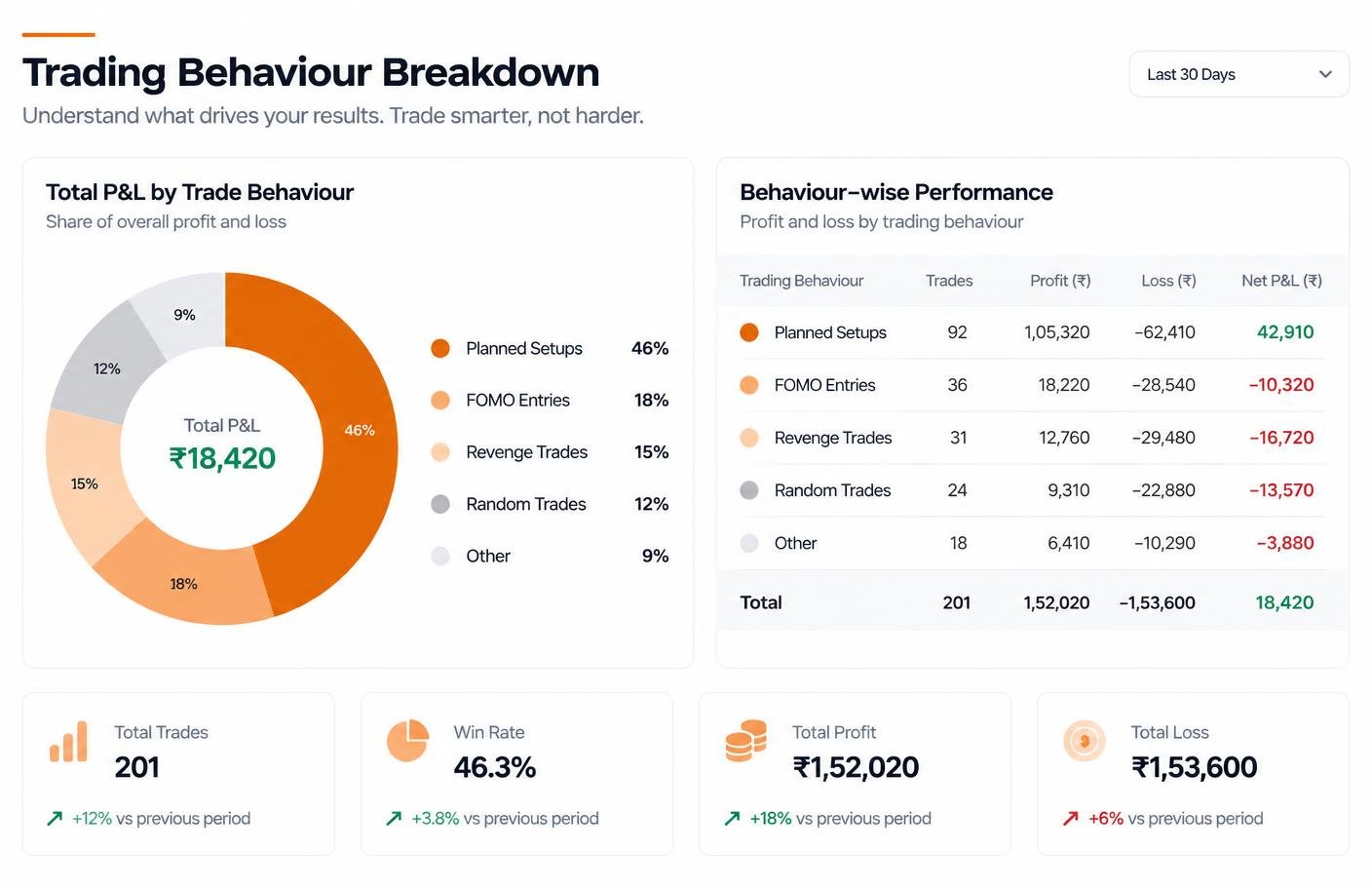
Suppose you made 80 trades during a month and finished with a loss of ₹18,000. Knowing that you lost ₹18,000 isn't enough. You want to know where that loss came from.
| Trading behaviour | Trades | Result |
|---|---|---|
| Planned setups | 32 | +₹21,500 |
| FOMO entries | 14 | -₹12,800 |
| Revenge trades | 11 | -₹16,400 |
| Random / no setup | 15 | -₹8,700 |
| Other | 8 | -₹1,600 |
Suddenly the month looks completely different. Your strategy may not necessarily be failing. Your unplanned trades may be destroying the profit created by your good trades. That's the kind of information a proper journal should uncover.
What Should You Record in a Trading Journal?
Don't make journaling unnecessarily complicated. If your journal takes ten minutes to complete after every trade, there is a good chance you'll eventually stop using it. Start with information that can actually help you make decisions.
1. Basic trade information
Date, trading instrument, buy or sell, entry price, exit price, quantity, stop-loss, target and profit or loss. For options trades, also record strike price, CE or PE, and expiry.
NIFTY 24500 CE
24 September expiry
This is far more useful later than simply writing "NIFTY option trade".
2. Your trading setup
Every trade should ideally have a reason.
Use the same setup names consistently. After 50 or 100 trades you can compare them. You may discover that your breakout trades perform well while your reversal trades consistently lose money. Without tagging your setups, both simply appear as trades.
3. Why did you enter the trade?
Write one short sentence. That's enough.
"Price broke yesterday's high with strong volume and the broader market was bullish."
"Entered because I saw a sudden move and didn't want to miss it."
The second sentence may be uncomfortable to write. That's exactly why journaling works. You are creating a record of what actually happened rather than what you would like to believe happened.
4. Track your emotions
Trading is one of the few activities where your emotional state can directly influence a financial decision within seconds. So record it.
Performance by emotional state
- Calm trades: +₹31,400
- FOMO trades: -₹18,700
- Frustrated trades: -₹22,300
That is actionable information. Instead of telling yourself "I need more discipline", you now have evidence showing exactly what undisciplined trading is costing you.
5. Record your mistakes
A losing trade isn't automatically a bad trade. And a profitable trade isn't automatically a good trade.
Good process / losing trade
- Followed setup
- Respected stop-loss
- Loss: ₹1,500
Bad process / profitable trade
- Random entry
- Doubled quantity
- Ignored stop-loss
- Profit: ₹8,000
Financially, the second trade won. From a process perspective, it may have been the worse trade.
Over time, your goal isn't simply to increase your win rate. It is to reduce repeated mistakes.
Win Rate Alone Can Be Misleading
Trader A
- 8 wins out of 10 trades
- Average winner: ₹500
- Average loser: ₹3,000
- ₹4,000 profit from winners
- ₹6,000 loss from losers
- Net result: -₹2,000
Trader B
- 5 wins out of 10 trades
- Average winner: ₹2,000
- Average loser: ₹800
- ₹10,000 profit from winners
- ₹4,000 loss from losers
- Net result: +₹6,000
Trader B has a lower win rate but a better outcome. That's why your trading journal should help you look beyond a single number.
Overtrading Usually Shows Up in the Data
Many traders start the session calmly, take one or two planned trades and then keep going. A journal that records the trade number for the day makes that drift visible: the first few trades are often planned, and the later ones are often reactions.
The data gives you a more complete picture than a single daily P&L figure.
Trading Journal for Options Traders
An options trading journal for Indian traders needs slightly different information from a normal equity journal. Consider tracking the underlying, strike price, CE or PE, expiry, entry premium, exit premium, quantity or lots, strategy, entry and exit time, stop-loss, market view, result, emotion and mistake.
If you trade strategies such as straddles, strangles, spreads or iron condors, tag the strategy consistently. After enough trades, you may discover that one type of options strategy fits you far better than another — or that the strategy isn't the issue at all, and you simply perform well before noon and badly after 1:30 PM.
Trading Journal for Intraday Traders
Intraday traders should pay particular attention to time and frequency: entry time, exit time, trade number for the day, setup, market condition, emotion, and whether the trade was planned.
A typical session
- 9:30 AM — Planned trade
- 10:15 AM — Planned trade
- 11:40 AM — Small loss
- 12:05 PM — Revenge trade
- 12:18 PM — Another trade
- 12:32 PM — Quantity increased
- 12:45 PM — Large loss
Looking only at the final daily P&L hides that sequence. A journal makes it visible.
Excel vs a Trading Journal App
Can you maintain a trading journal in Excel or Google Sheets? Absolutely. For a trader who is just starting, a spreadsheet can work well.
| Feature | Spreadsheet | Trading journal app |
|---|---|---|
| Flexible | Yes | Yes |
| Low cost | Yes | Depends on app |
| Manual setup | High | Low |
| Mistake tracking | Manual | Easier |
| Emotion tracking | Manual | Easier |
| Charts | Manual setup | Automatic |
| Behaviour analysis | Difficult at scale | Easier |
| Screenshots and notes | Can become messy | Organized |
The advantage of spreadsheets is obvious: they are flexible and inexpensive. The problem usually appears later. As your trade history grows, finding useful behavioural patterns becomes harder.
The right choice depends on your needs. If a spreadsheet helps you journal consistently, use it. The goal isn't to use fancy software. The goal is to learn from your trades.
How Often Should You Review Your Trading Journal?
After the trading day
- What went well?
- What went wrong?
- Did I follow my plan?
- Which mistake did I repeat?
- Did emotion affect any decision?
Don't write an essay. A few honest sentences are enough.
Weekly review
- Which setup made the most money?
- Which setup lost the most?
- What was my most common mistake?
- Did I overtrade?
- Which emotional state produced my worst trades?
- Did I follow my stop-loss?
- Were my losses mainly strategy losses or execution mistakes?
Monthly review
Monthly reviews help you zoom out. Compare setups, days, instruments, mistakes and emotions, then make one or two changes for the following month. Not ten. A journal works best when it leads to a specific behavioural change.
The Biggest Trading Journal Mistake
The biggest mistake isn't forgetting a field. It's lying to your own journal.
"If a trade was taken because of FOMO, write FOMO."
If you revenge traded after a loss, write revenge trade. If there was no setup, don't invent one later. Nobody else needs to see it.
The value of a trading journal depends on how accurately it represents your actual behaviour. A perfect-looking journal containing inaccurate information is almost useless. An imperfect journal containing honest information can be extremely valuable.
How MyTradeDiary Approaches Trading Journaling
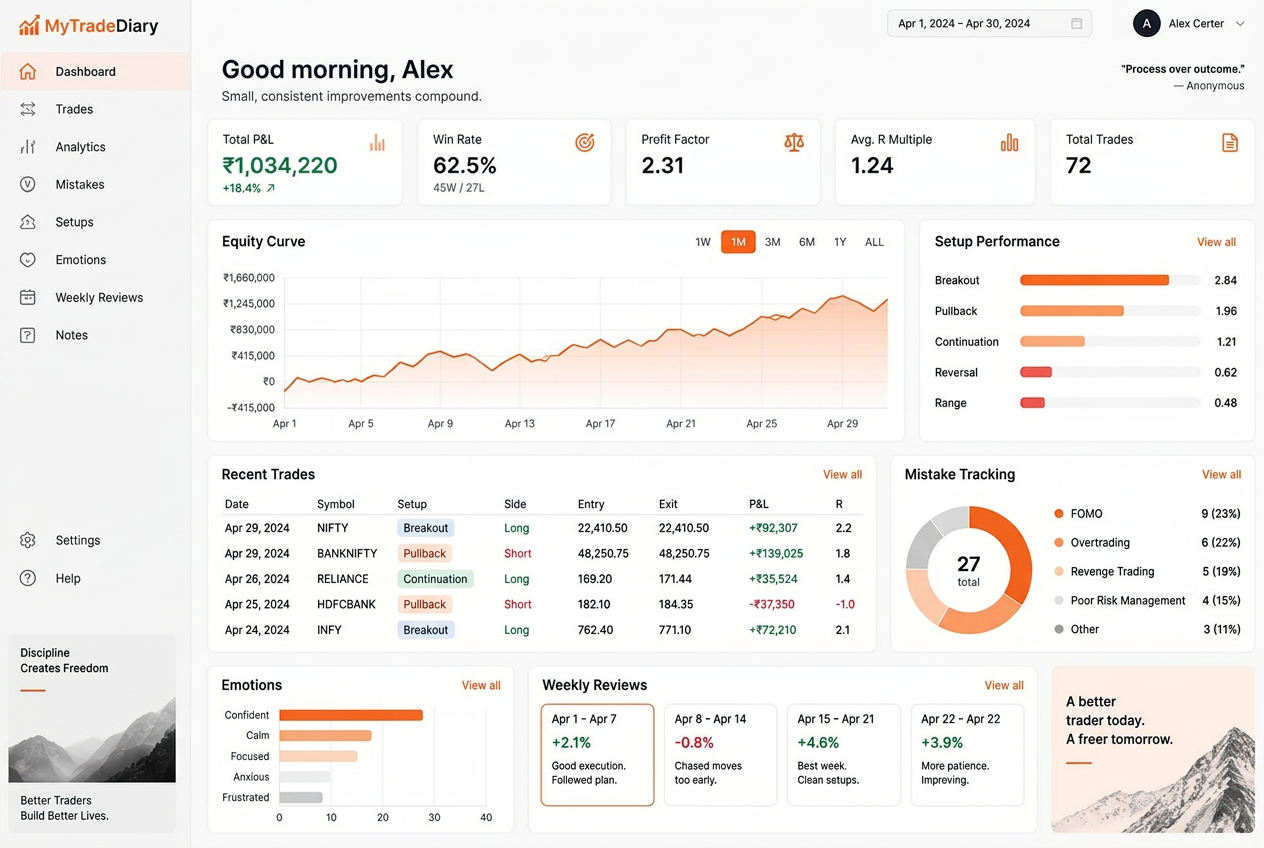
This is also the reason we built MyTradeDiary. We wanted a journal to record more than entry price, exit price and P&L.
Your trading data should help you understand yourself as a trader.
If your results show that a particular setup works, you should be able to see it. If revenge trading is repeatedly costing you money, you should be able to see that too. If your best trades happen when you follow one specific process, that pattern shouldn't remain hidden inside hundreds of trades.
How to Start Your Trading Journal Today
Don't wait until you have the perfect journal. Start with your next trade.
Record the trade, the setup, why you entered, how you felt, whether you followed your rules and what you learned. Then do it again. After twenty trades, review them. After fifty trades, review them again.
After one hundred trades, you will have something far more valuable than a collection of screenshots and P&L numbers. You will have data about how you actually trade. And once you can see your behaviour clearly, you have something you can work on.
Frequently Asked Questions
What is a trading journal?
A trading journal is a structured record of your trades, including information such as entry and exit, profit or loss, strategy, trading setup, mistakes, emotions and observations. It helps traders review their past decisions and identify recurring patterns.
Which is the best trading journal for Indian traders?
The right trading journal depends on how you trade. Beginners may be comfortable starting with Excel or Google Sheets. Traders who want easier mistake tracking, emotion tracking, setup analysis and performance reviews may prefer a dedicated trading journal application.
Is a trading journal useful for options trading?
Yes. Options traders can use a journal to track underlying instruments, strikes, CE or PE positions, expiry dates, strategies, entry and exit premiums, results, mistakes and emotional behaviour.
Is a trading journal useful for intraday trading?
Yes. Intraday traders can particularly benefit from tracking entry time, trade frequency, setups, mistakes and emotional states because their behaviour can change significantly during a single trading session.
What should I write in my trading journal?
At minimum, record your instrument, entry, exit, quantity, profit or loss, setup, reason for entry and whether you followed your trading plan. Adding mistakes and emotional states can make the journal much more useful.
Can I use Excel as a trading journal?
Yes. Excel and Google Sheets are perfectly valid ways to start journaling. Dedicated trading journal software becomes useful when you want easier filtering, behavioural analysis, visual dashboards or a simpler review process.
How often should I review my trading journal?
A short daily review combined with a more detailed weekly review works well for many traders. A monthly review can then be used to identify larger patterns and decide what to improve in the following month.
Does maintaining a trading journal make you profitable?
No trading journal can guarantee profits. A journal is a review and analysis tool. It can help you identify patterns, repeated mistakes and strengths in your own trading, but trading always involves risk.