
Trading Psychology Journal: Track FOMO, Fear, Revenge Trading & Discipline
MyTradeDiary Editorial Team · Published 18 September 2026 · Updated 18 September 2026 · 13–16 min read
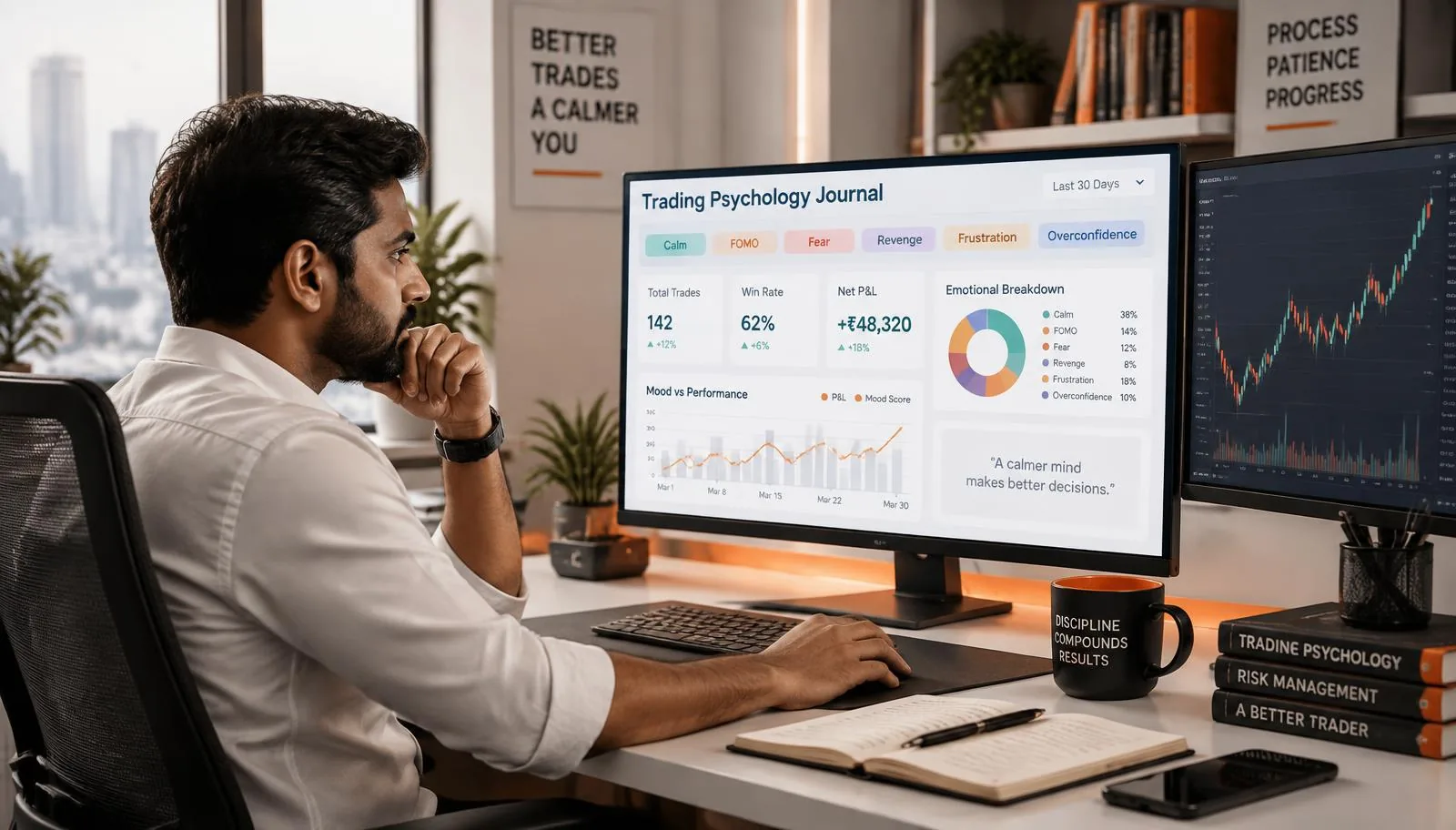
You know your setup. You know where your stop-loss should be. You know how much you are supposed to risk. Then the market opens.
Price moves quickly. You miss the entry. A few seconds later, you enter anyway. The trade goes against you and you take the loss. Five minutes later you are back in another position — this time with a larger quantity.
At the end of the day you look at your P&L and think: “My strategy isn’t working.” Maybe. But perhaps the strategy wasn’t the only thing trading that day.
- Your frustration was trading.
- Your fear of missing out was trading.
- Your need to recover the previous loss was trading.
- Your overconfidence after yesterday’s profit may have been trading too.
A normal trade journal tells you what you traded, where you entered, where you exited and how much you made or lost. A psychology-focused journal adds another layer: what were you feeling, what triggered that emotion, did your behaviour change, and did you follow your original plan?
The goal isn’t to remove emotions from trading. That isn’t realistic. The goal is to understand when emotions begin changing your decisions.
In this guide
- What Is a Trading Psychology Journal?
- Why Track Emotions?
- Emotion vs Behaviour
- What Should You Record?
- FOMO
- Revenge Trading
- Fear
- Greed
- Frustration
- Overconfidence
- Hesitation
- Boredom
- Regret
- Tilt
- Emotional Triggers
- Before and After the Trade
- Confidence Tracking
- Discipline Tracking
- Daily Psychology Review
- Weekly Psychology Review
- Turning Notes Into Rules
- MyTradeDiary
- FAQ
What Is a Trading Psychology Journal?
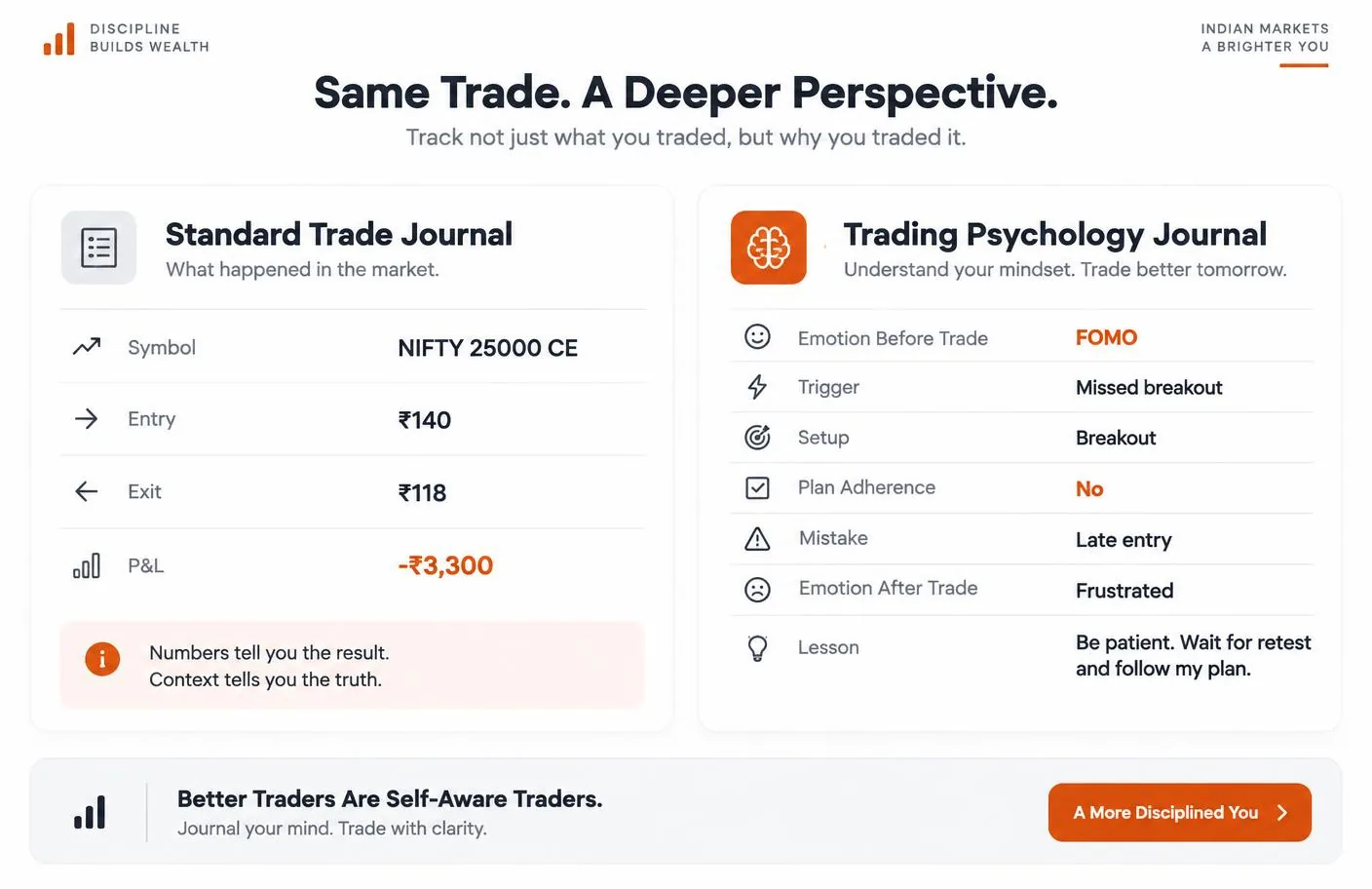
A trading psychology journal is a record of the emotional and behavioural context surrounding your trading decisions. Instead of only recording “NIFTY 25000 CE · Entry ₹140 · Exit ₹118 · Loss -₹3,300”, you also record how the decision was made.
The same trade, with psychology context
- Emotion before entry
- FOMO
- Trigger
- Missed the original breakout.
- Entry reason
- Price continued rising without me.
- Plan followed
- No
- Mistake
- Late entry
- Emotion after exit
- Frustrated
- Next action
- Entered another trade seven minutes later.
- Lesson
- Missing a trade does not create a new setup.
The first version records the transaction. The second version records the decision-making process.
Why Track Emotions in Trading?
Emotions are not automatically trading mistakes. Being nervous does not mean your trade is wrong. Feeling confident does not mean your trade is right. Feeling frustrated does not guarantee your next trade will fail.
The useful question is different: does a certain emotional state repeatedly change how you execute your trading plan?
- When calm, you may wait for confirmation.
- When experiencing FOMO, you may enter late.
- When frustrated, you may trade more frequently.
- When afraid, you may exit winners early.
- When overconfident, you may increase position size.
- When trying to recover a loss, you may accept weaker setups.
The emotion itself isn’t necessarily the problem. The behaviour that follows it may be.
Emotion and Behaviour Are Not the Same Thing
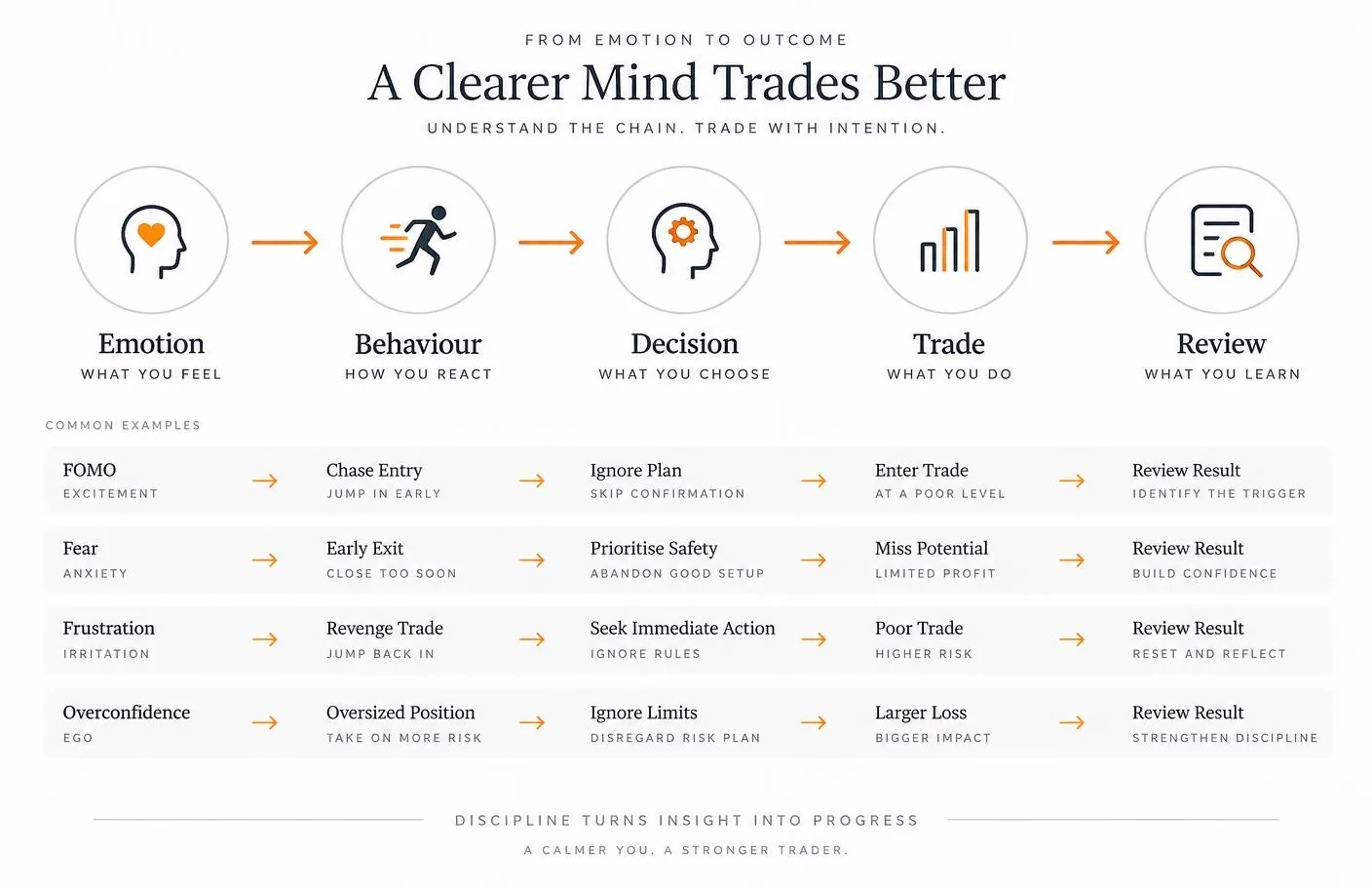
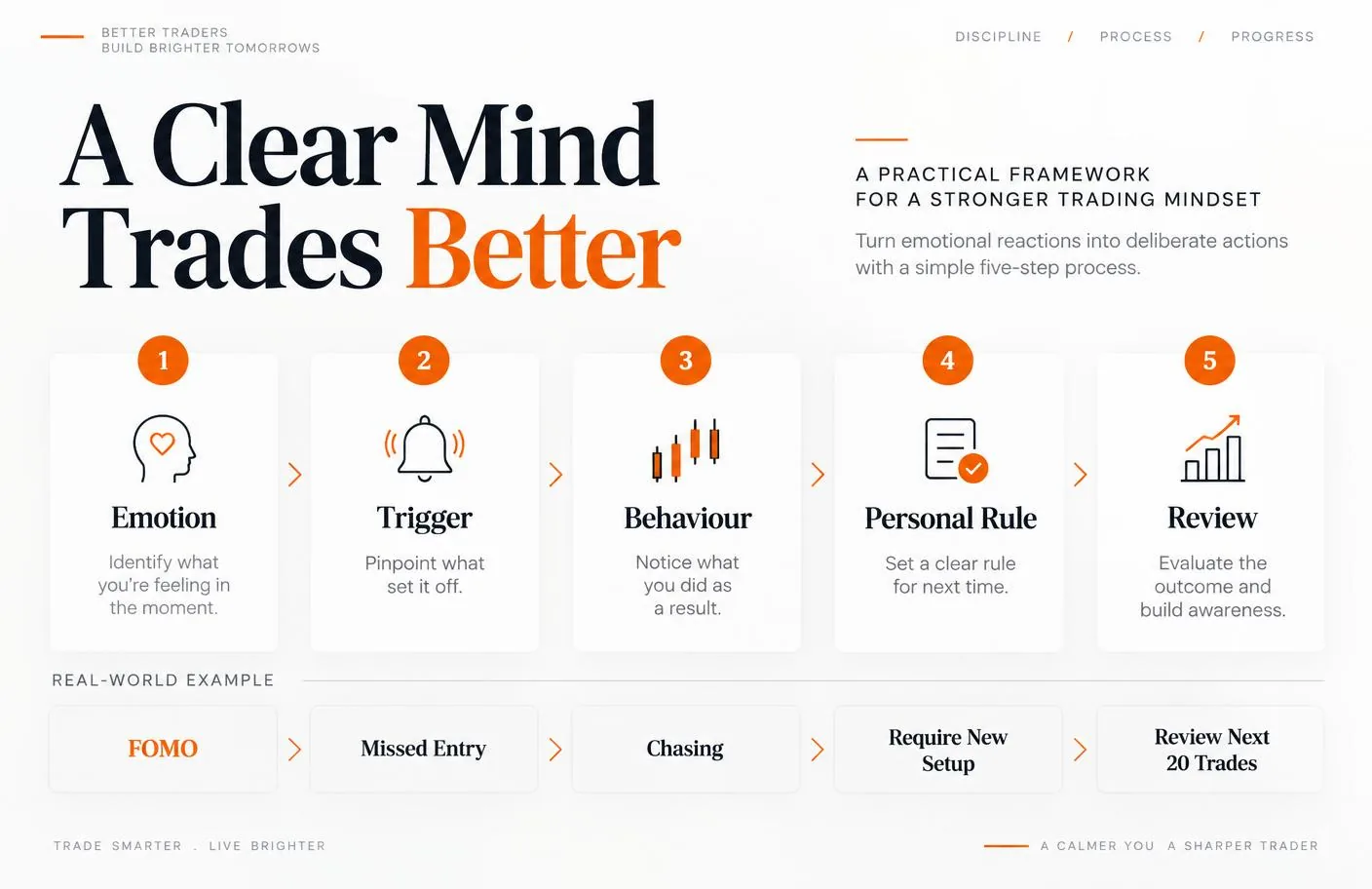
Suppose two traders both feel nervous. Trader A waits for the setup, uses normal position size, places the planned stop and follows the exit rule. Trader B cuts the trade early, re-enters, changes position size and starts watching every tick.
The emotion may be similar. The behaviour is different. This is why your journal should not stop at “Emotion: Fear.” Add another field: what did that emotion make me do?
EXAMPLE 1
- Emotion
- Fear
- Behaviour
- Followed plan anyway
Result: process unchanged
EXAMPLE 2
- Emotion
- Fear
- Behaviour
- Exited before planned level
Result: process changed
The objective isn’t to eliminate fear. It is to notice whether fear is controlling execution.
What Should You Record in a Trading Psychology Journal?
Keep the system simple enough to use after every important trade. You don’t need to write a diary entry after every candle — track information that helps you review behaviour later.
1. Emotion before the trade
2. Emotion intensity
An optional 1–5 scale, from very low to very high. A small amount of anxiety and extreme anxiety may affect behaviour differently, so intensity gives the tag context.
3. Trigger
What happened immediately before the emotion?
- Missed entry or a previous loss
- Consecutive losses or a large winning trade
- Seeing price move quickly, or sudden volatility
- A social media tip or another trader’s result
- Approaching your daily target or maximum loss
- A slow market, or a sharp reversal
4. Trading behaviour
5. Plan adherence
Three options are usually enough: Yes, Partially, No.
6. Emotion during the trade
The feeling before entry is often different from the feeling while the position is open.
7. Emotion after the trade
8. Lesson
One short sentence. For example: “After missing an entry, I should wait for a new setup instead of chasing the same move.”
1. FOMO: The Fear of Missing the Move
FOMO often starts before the trade. You identify an entry. Price reaches it. You hesitate. Then price moves without you. The original question — “Is this still a valid setup?” — quietly becomes “What if it keeps going without me?”
Illustrative example
- Planned entry
- ₹150
- Price path
- ₹150 → ₹158 → ₹166
- Actual entry
- ₹167
- Why
- “I didn’t want to miss the move.”
- Emotion
- FOMO
- Plan followed
- No
Did the setup improve between ₹150 and ₹167, or did urgency increase? A possible personal review rule: if the planned entry is missed, require a new valid setup before entering. This is an example review rule, not a universal trading recommendation.
2. Revenge Trading: When the Previous Trade Controls the Next One
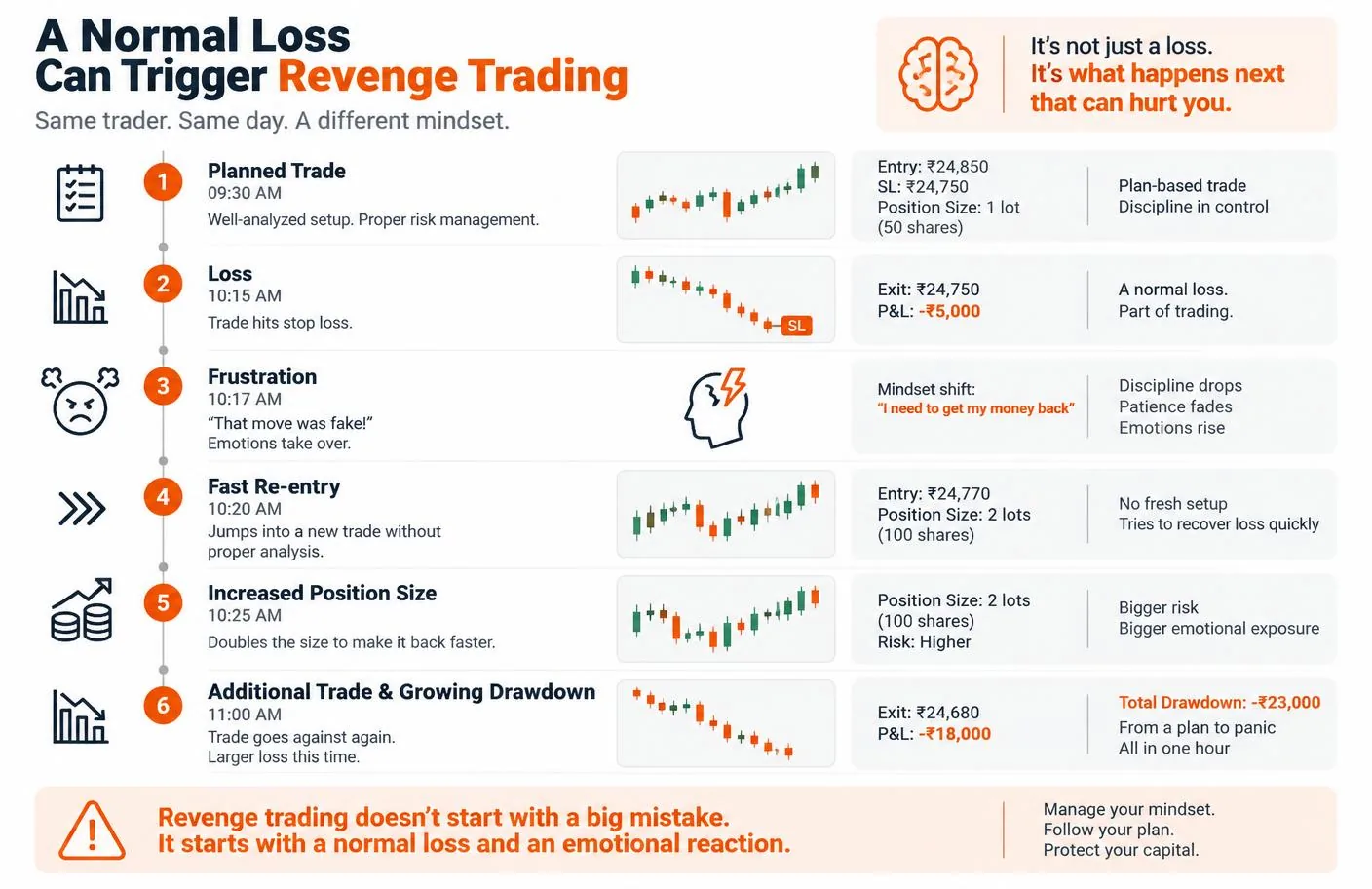
A new trade should ideally be evaluated on its own merits. Revenge trading occurs when the emotional impact of a previous result begins influencing the next decision. The internal dialogue may sound like “I need to make it back”, “one more trade”, or “I can’t finish the day negative”.
Illustrative session timeline
- 9:38 AM · Trade 1 · planned setup+₹1,600
- 10:12 AM · Trade 2 · planned setup-₹2,500
- 10:19 AM · Trade 3 · rapid re-entry, low setup qualityEmotion: frustrated
- 10:31 AM · Trade 4 · position size increasedEmotion: revenge mindset
- 10:47 AM · Trade 5 · another entryDaily drawdown increases
The important information is not simply that trades 3–5 lost money. It is that the decision process changed after trade 2.
3. Fear: When Protecting Yourself Changes the Trade
Fear does not only appear before a loss. It can also appear when a trade is profitable. You enter at ₹200 with a target of ₹240. Price reaches ₹212, you see a small pullback and exit at ₹208 — not because your setup changed, but because you didn’t want the open profit to disappear.
Journal fields · example
- Planned exit
- ₹240
- Actual exit
- ₹208
- Reason
- Fear of losing open profit
- Setup invalidated?
- No
- Tag
- FEAR EXIT
This does not mean every early exit is wrong. Market conditions change and traders use discretionary exits. The useful question is whether fear repeatedly causes you to abandon your own planned process.
4. Greed: When “Enough” Keeps Moving
Greed is difficult to track because it often looks like confidence. Your target is reached and your plan says exit. Instead you think “just a little more.” Price continues temporarily, you move the target again, then again, and eventually a reversal reduces the gain substantially.
Record the original target, the actual exit, why the target changed, whether that change was part of predefined management, and the emotion involved.
Changing a target according to a defined trailing strategy is different from repeatedly changing it because you want more.
5. Frustration: The Emotion That Can Change Trade Frequency
Frustration may appear after a losing trade, a missed trade, an early exit, a platform issue, a stop followed by an immediate reversal, or several small losses. The danger is not frustration itself — it is what happens next.
BEFORE FRUSTRATION
- Average gap between trades
- 38 minutes
- Typical quantity
- 100
AFTER FRUSTRATION
- Average gap between trades
- 9 minutes
- Typical quantity
- 175
Illustrative example only.
This kind of comparison can reveal behaviour that is difficult to remember accurately.
6. Overconfidence: Psychology Problems Can Follow Winning Trades Too
Trading psychology is often discussed only in relation to losses. But profitable periods can change behaviour too. After several successful trades, a trader may increase size, take weaker setups, skip confirmation, trade more frequently or assume the next position will also work.
Illustrative sequence
- Trade 1 · followed plan · profit
- Trade 2 · followed plan · profit
- Trade 3 · followed plan · profit
- Trade 4 · quantity increased, weak setup accepted
- Trade 5 · another increase in size
7. Hesitation: When You Don’t Take the Trade You Planned
Not every psychology problem creates an extra trade. Some prevent valid trades. Your setup appears, conditions are met, risk is within plan — but the previous two trades lost. You hesitate and skip the trade. The setup works. Frustration builds, and that may eventually create FOMO.
Skipped trade · example
- Valid setup?
- Yes
- Trade taken?
- No
- Why
- Fear after previous losses
- Emotion
- Hesitant
A psychology journal can contain both trades and meaningful non-trades. You do not need to record every opportunity you ignore, but repeatedly skipping your own valid setups because of emotion may be worth reviewing.
8. Boredom: When You Trade Because Nothing Is Happening
A slow session creates a different kind of pressure. You have been watching the screen. No setup appears. An hour passes, then another. Eventually an average-looking opportunity begins to feel attractive simply because it is something to do.
A useful question: if I had opened the chart thirty seconds ago, would I still consider this a valid trade?
Record with the BOREDOM TRADE tag
- Time spent watching before entry
- Setup quality
- Reason for entry
- Emotion
9. Regret: When the Trade You Didn’t Take Affects the Trade You Do Take
You identify a move and do not enter. The market moves exactly as expected. Now you feel regret. The next setup appears and you enter faster than usual, or with larger size, or you chase. The previous non-trade is influencing the next trade.
- Trigger
- Missed profitable move
- Emotion
- Regret
- Next behaviour
- Chased following setup
10. Tilt: When Several Emotions Affect the Whole Session
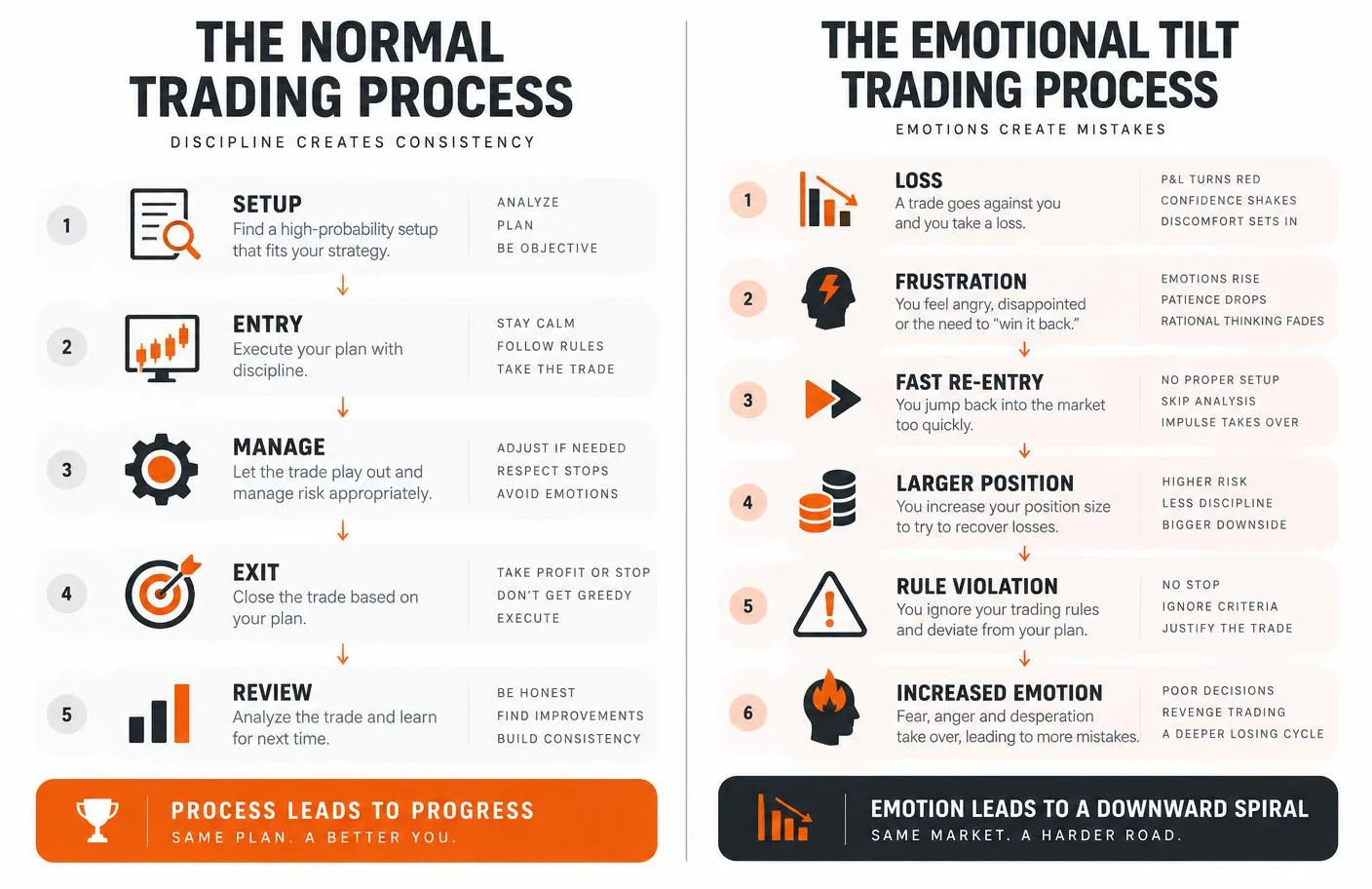
“Tilt” is an informal trading term for a state where frustration, anger, urgency or loss of discipline begins affecting a series of decisions rather than one isolated trade. Instead of one mistake, you may see a cluster: a loss, frustration, a rapid re-entry, a larger quantity, a moved stop, another loss and another immediate trade.
NORMAL STATE
Setup → Entry → Manage → Exit → Review
TILT STATE
Loss → Emotion → Re-entry → Larger size → Rule break → More emotion
The journal should make the sequence visible. Tilt is used here only as an informal description of trading behaviour, not as any kind of diagnosis.
Track Emotional Triggers, Not Just Emotions
Writing “today I felt frustrated” is useful. This is more useful:
Illustrative entry
- Emotion
- Frustrated
- Trigger
- Stop-loss hit followed by immediate price reversal.
- Behaviour
- Re-entered without setup.
- Mistake
- Revenge trade
- Result
- -₹2,700
- Lesson
- A stop-out does not automatically justify re-entry.
Common triggers include losses and consecutive losses, missed opportunities, a stop followed by a reversal, winning streaks, a large open profit, social media, another trader’s result, sudden volatility, a slow market, the approach of the closing bell, or nearing your daily target or maximum loss.
Check Your Emotional State Before You Enter
Most journals are completed after the trade. Consider adding one quick pre-trade check — it can take a few seconds.
How do I feel right now?
How strong is it?
1 · 2 · 3 · 4 · 5
Does this match my setup?
Yes / No / Not sure
Normal position size?
Yes / No
The objective isn’t to prevent a trade automatically. It is to make your emotional state visible before the decision is complete.
Your psychology after a loss
One of the most useful analyses is not “how do I feel when I lose?” but “how does a loss affect the next trade?” A sequence such as loss → six minutes → low setup quality → increased size → frustration → another loss says more than either trade alone. It can help to measure your average time to the next trade after a winner, a loser, a large loss and a missed trade.
Your psychology after a big winning trade
A large winner can affect the next decision too: increasing quantity, accepting weaker setups, taking more trades, reducing preparation or relaxing normal risk controls. A useful journal question is “what changed in my next three trades after a large winning trade?” Test whether it actually happens in your own history rather than assuming it does.
THE 60-SECOND REVIEW
- What was my emotion before entry?
- What triggered it?
- Did I follow my setup?
- Did emotion change my position size?
- Did emotion change my stop?
- Did emotion change my exit?
- What did I feel immediately after the trade?
- Would I take the same trade again under my rules?
- What is one sentence I want to remember?
A short review completed consistently is more useful than an elaborate questionnaire you stop using after a week.
Confidence Is Worth Tracking — But Don’t Confuse It With Accuracy
You can optionally rate confidence before each trade, then compare high, medium and low-confidence trades later. Interpret it carefully: confidence does not predict whether a trade will win. The useful question is whether your confidence level affects your behaviour — size, stops, risk controls or hesitation despite a valid setup.
Sample data only
- Confidence 8–10
- Plan violations: 18%
- Confidence 5–7
- Plan violations: 7%
- Confidence 1–4
- Plan violations: 11%
This example does not show that high confidence is bad. It shows how confidence can be compared with behaviour rather than simply compared with profit.
Trading Discipline Should Be Measured by Behaviour, Not P&L
DAY A
+₹8,000
- 3 FOMO entries
- 2 position-size violations
- 1 moved stop-loss
- Daily trade limit exceeded
DAY B
-₹2,500
- All setups followed
- Normal position size
- Stops respected
- No revenge trade
- Stopped according to plan
Illustrative example only.
From a P&L perspective, Day A looks better. From a process perspective, Day B may have been the more disciplined session. To ask similar questions before each entry rather than after, you can use the free pre-trade checklist.
Daily discipline checklist · Yes or No
- Did I trade only valid setups?
- Did I respect my position-size rule?
- Did I respect stops?
- Did I remain within my trading limit?
- Did I avoid revenge trading?
- Did I follow my exit process?
- Did I stop according to my plan?
An optional discipline score
Some traders find a simple daily score useful. This is an example scoring framework, not a validated system. Score one point each for following your setups, respecting position size, respecting stop-loss rules, avoiding emotional re-entry and staying within your planned trading limits. A 5/5 day means rules were followed; 3/5 means some were broken and worth reviewing. The score evaluates process adherence for that session only — it does not describe you as a trader.
Compare emotions with behaviour, not just P&L
A common analytics mistake would be concluding “FOMO trades lost money, therefore FOMO always causes losses.” That is too strong. Examine several dimensions instead.
| Emotion | Trades | Plan followed | Trade frequency | Size violations | Associated P&L |
|---|---|---|---|---|---|
| Calm | 42 | 90% | Normal | 0 | Positive |
| FOMO | 18 | 39% | Higher | 5 | Negative |
| Frustrated | 11 | 45% | Much higher | 4 | Negative |
| Overconfident | 9 | 56% | Normal | 6 | Mixed |
Illustrative data only.
The goal is to identify associations in your own trading history. A journal cannot prove that one emotion directly caused a particular financial outcome.
Your Daily Trading Psychology Review
- What emotion appeared most often today?
- Which trade was most emotionally difficult?
- Did a loss change my next decision?
- Did a winner change my next decision?
- Did I take a FOMO trade?
- Did I revenge trade?
- Did I increase position size emotionally?
- Did fear cause an early exit?
- Did I skip a valid setup because of fear?
- Did boredom create a trade?
- When did my discipline start declining?
- Which decision am I most satisfied with from a process perspective?
- What one behaviour should I watch tomorrow?
Your Weekly Trading Psychology Review
Individual trades can feel random. Weekly reviews allow patterns to emerge.
Most common emotion
FOMO
Most common trigger
Missed entry
Most common behaviour
Late entry
Most common rule violation
Trade limit exceeded
Best discipline day
Wednesday
Most difficult period
After consecutive losses
Illustrative example.
- Which emotion most often coincided with rule-breaking?
- What usually triggered FOMO?
- What happened after losses, and after large wins?
- Did trade frequency change when frustrated?
- Did position size change when overconfident?
- Which rule was hardest to follow, and which behaviour improved?
- What should be the focus for next week?
Don’t Try to Become Emotionless — Turn Notes Into Rules
The goal is not “I should feel nothing while trading.” A better objective is “I want to notice when my emotional state changes my trading process.” You can feel nervous and follow your rules. You can feel disappointed after a loss and still wait for the next valid setup. Your emotional state is information; your actions remain decisions.
Avoid vague journal conclusions. Make them specific enough to check later.
| Instead of | Write |
|---|---|
| “I need more discipline.” | “When I have two consecutive losses, I will review my next setup before entering.” |
| “Stop FOMO.” | “If the planned entry is missed, I will wait for a new setup rather than chase the original move.” |
| “Control fear.” | “I will not exit solely because open profit temporarily decreases unless my exit condition is met.” |
These are examples of how to make personal journal rules more specific. They are not universal trading strategies.
Trading Psychology Journal vs a Normal Trading Journal
| Normal trading journal | Psychology journal |
|---|---|
| Instrument | Instrument |
| Entry | Entry |
| Exit | Exit |
| P&L | P&L |
| Setup | Setup |
| Stop-loss | Emotion before trade |
| Target | Emotional trigger |
| Notes | Behaviour |
| — | Plan adherence |
| — | Emotion during trade |
| — | Emotion after trade |
| — | Psychology lesson |
You do not necessarily need two separate journals. Psychology tracking can simply become another layer inside your existing log. For the complete structure, read our trading journal guide for Indian traders.
How Psychology Tracking Connects With Mistake Tracking
Emotions and mistakes are related, but they are not identical.
| Emotion | Mistake that may follow |
|---|---|
| Frustration | Revenge trade |
| FOMO | Late entry |
| Fear | Early exit |
| Overconfidence | Oversized position |
If you want the behavioural half of this system in detail, see the trading mistake tracker guide.
Trading Psychology for Options Traders
Options traders may find psychology tracking particularly useful because decisions often happen quickly and involve several variables at once: contract, strike, expiry, quantity, premium, setup, emotion, trigger, mistake and plan adherence.
NIFTY 25000 CE · example
- Emotion
- FOMO
- Trigger
- Premium moved quickly after missed entry.
- Behaviour
- Chased.
- Mistake
- Late entry
This helps you separate “the option lost money” from “I changed my normal entry process because I was afraid of missing the move.” The options trading journal guide covers the contract-level fields in more depth.
How MyTradeDiary Helps You Track Trading Psychology
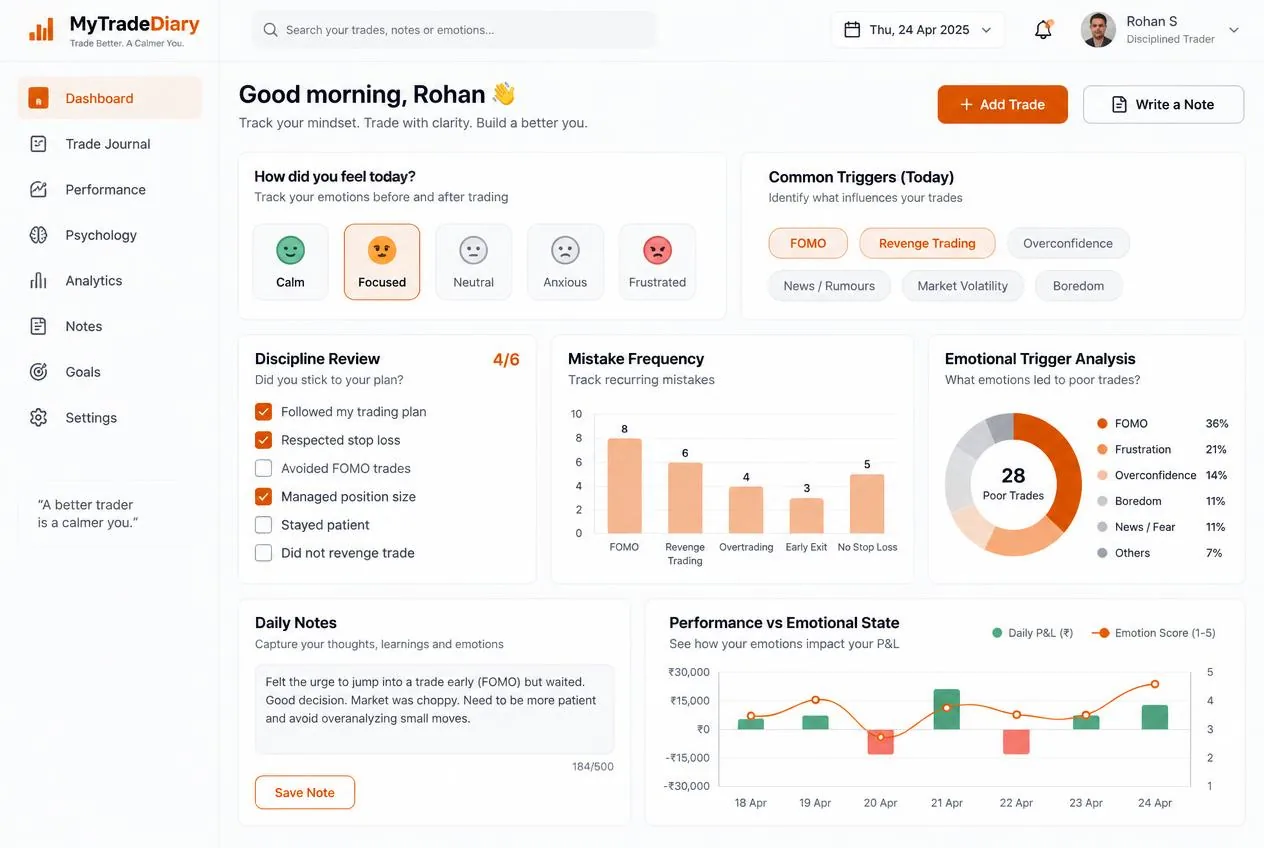
A trader should be able to review not only what they traded, but how they behaved around those trades. MyTradeDiary keeps trade details, setups, mistakes, emotions, daily notes and review history in one place.
Emotion tracking
Record how you felt around a trading decision.
Mistake tracking
Connect emotions with repeated trading errors.
Setup tracking
Separate strategy behaviour from emotional behaviour.
Daily notes
Record what happened during the trading session.
Discipline review
Review whether your own trading rules were followed.
AI journal summary
Summarise recurring themes from your journal history to make review easier.
Understand the Behaviour Behind Your Trades
Keep your trades, setups, mistakes, emotions and reviews together with MyTradeDiary.
How to Start a Trading Psychology Journal Today
Don’t begin with twenty emotions and a complicated scoring system. Start with five.
For your next trade, record the emotion before entry, the trigger, whether you followed your setup, whether your behaviour changed, the emotion after exit and one lesson. Do this consistently.
- After 20 trades, read the entries and look for repetition.
- After 50 trades, compare emotions with plan adherence, trade frequency, position size, mistakes and exits.
- Add more categories only when they become useful.
Your journal should become more useful over time, not more complicated.
Trading Psychology Journal FAQ
What is a trading psychology journal?
A trading psychology journal records the emotional and behavioural context surrounding trading decisions. In addition to normal trade information, it may include emotions, triggers, plan adherence, mistakes and lessons.
What emotions should traders track?
Useful categories may include calm, confidence, fear, FOMO, frustration, greed, hesitation, boredom, revenge mindset and overconfidence. Traders do not need to track every possible emotion; the categories should remain simple enough to use consistently.
How do I track FOMO in trading?
Record when FOMO occurs, what triggered it and what behaviour followed. For example, a missed entry may trigger FOMO, which then leads to chasing price or taking a late entry.
How do I track revenge trading?
Record the trade immediately before the suspected revenge trade, your emotional state, the time between trades, whether the next trade had a valid setup and whether your position size changed.
Is fear always bad in trading?
No. Feeling fear or anxiety does not automatically mean a trading decision is wrong. Psychology journaling is more useful when it examines whether the emotion causes you to change or break your own trading process.
Can a trader be overconfident after winning trades?
It can happen. A journal can help identify whether winning streaks coincide with behaviours such as increased position size, weaker setup selection or increased trading frequency. This should be evaluated from the trader's own historical records rather than assumed.
What is trading tilt?
Tilt is an informal trading term often used to describe a period when frustration, anger or urgency begins affecting several trading decisions in sequence. It is not used here as a medical or psychological diagnosis.
Should I rate my emotions from 1 to 10?
You can, but it is not necessary. A simple low-to-high scale such as 1–5 may be easier to use consistently. The purpose of the score is to add context, not to create a clinical measurement.
How often should I review trading psychology?
A short post-trade or end-of-day review can capture immediate context, while weekly and monthly reviews can help identify repeated patterns.
Can a trading psychology journal improve profitability?
A trading psychology journal cannot guarantee profitability. It is a review tool that can help traders examine historical decisions, emotions and behaviour more systematically.
Can I create a psychology journal in Excel?
Yes. Excel or Google Sheets can be used by adding columns for emotion, trigger, behaviour, mistake, plan adherence and lesson. Dedicated journaling software may make filtering and long-term analysis easier.
What is the difference between emotion and a trading mistake?
An emotion describes how you felt, such as fear or frustration. A mistake describes an action or process violation, such as moving a stop-loss or entering without a setup. Tracking both can make behavioural patterns clearer.