
Trading Mistake Tracker: Find the Habits Hurting Your Trading
MyTradeDiary Editorial Team · Published 18 September 2026 · Updated 18 September 2026 · 12–14 min read

You close the trading day with a loss of ₹6,800. What caused it? A bad strategy, a difficult market, or simply bad luck? Maybe.
But there is another possibility. Perhaps the first trade was completely normal. The second was also within your plan. Then you took a loss. You entered again five minutes later. The next position was larger. You moved your stop-loss. Then you took one more trade because you wanted to recover before the market closed.
On your broker statement, all of those decisions eventually become one number: -₹6,800. But those trades did not fail for the same reason, and that distinction matters.
A trading mistake tracker helps you record the behaviour behind your trades so you can see which errors keep appearing. Instead of asking “Why am I losing?”, you can ask far more useful questions.
- How much of my trading comes from FOMO?
- Do I increase my position size after losses?
- Does my performance deteriorate after my third trade?
- How often do I move my stop-loss?
- Which mistake do I repeat most often?
This guide explains how to build a practical trading mistake tracking system and which mistakes are worth recording.
In this guide
- What Is a Trading Mistake Tracker?
- Losing Trade vs Trading Mistake
- Why Mistakes Should Be Tagged
- 15 Trading Mistakes Worth Tracking
- FOMO Trading
- Revenge Trading
- Overtrading
- Stop-Loss Mistakes
- Position Sizing
- Averaging Losers
- Trading Without a Setup
- Entry and Exit Timing
- The Cost of Each Mistake
- Trigger Tracking
- Mistake → Trigger → Rule → Review
- Daily Review
- Weekly Review
- Mistake Tracker vs P&L Dashboard
- MyTradeDiary
- FAQ
What Is a Trading Mistake Tracker?
A trading mistake tracker is a structured way to record mistakes that happen before, during or after a trade. It can sit inside your normal trading journal.
For example, instead of recording only “NIFTY 25000 CE · Entry ₹145 · Exit ₹118 · Loss -₹4,050”, you might also record the context around the decision.
NIFTY 25000 CE · with mistake context
- Setup
- Breakout
- Emotion
- FOMO
- Mistake
- Late entry
- Stop-loss
- Moved from ₹125 to ₹115
- Reason
- Entered after seeing a rapid premium move.
- Lesson
- Do not chase after the planned entry zone has passed.
Suddenly, one losing trade contains information you can actually review.
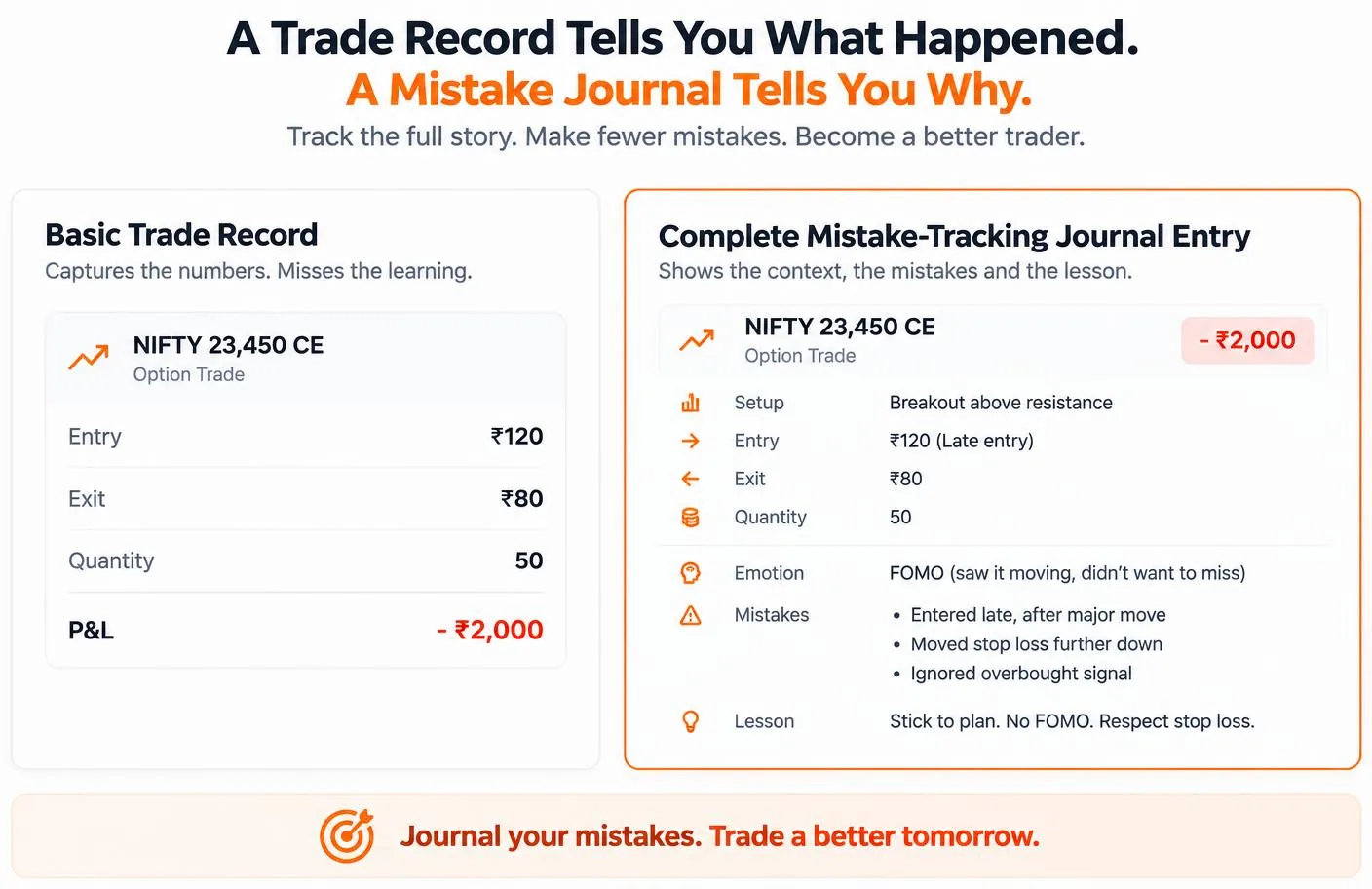
A Losing Trade Is Not Automatically a Trading Mistake
Markets are uncertain. You can follow your trading plan perfectly and still lose. This distinction sits at the centre of any useful mistake tracking system.
LOSING TRADE
- Planned setup
- Correct position size
- Stop followed
- Trading rules followed
Result: -₹2,000
Good process, losing outcome
PROFITABLE TRADE
- No setup
- Oversized position
- No planned stop
- FOMO entry
Result: +₹5,000
Poor process, profitable outcome
If your journal only evaluates profit and loss, the second trade looks superior. If your journal tracks behaviour, you get a far more useful picture of what you actually did.
Why You Should Tag Trading Mistakes
Imagine typing a paragraph after every trade: “I entered too late because I saw price moving quickly, felt I might miss the move, increased my quantity and then moved my stop when the position went against me.” That contains useful information. Analysing 200 paragraphs like it would be difficult.
Tags solve this problem.
You can still write a short note. But tags make repeated behaviour measurable. After 100 trades, instead of reading every note, you can ask how many FOMO trades you took, how many times you moved a stop, which mistake produced the largest total loss, and which mistake appears most often after a losing trade. That is when mistake tracking becomes genuinely useful.
15 Trading Mistakes Worth Tracking
FOMO Entry
Entering after the planned opportunity has already moved because you are afraid of missing it.
FOMORevenge Trading
Taking another trade mainly because you want to recover a recent loss.
REVENGEOvertrading
Continuing to enter trades despite declining setup quality or after reaching your planned limit.
OVERTRADINGMoving the Stop-Loss
Changing your stop farther away after the trade moves against you.
MOVED STOPNo Stop-Loss
Entering without clearly knowing where the trade idea becomes invalid.
NO STOPOversized Position
Taking more exposure than your normal trading plan allows.
OVERSIZEDAveraging a Losing Trade
Adding exposure after the position moves against you, without that addition being part of the original strategy.
AVERAGED LOSEREntering Without a Setup
Taking a trade that does not match one of your defined setups.
NO SETUPLate Entry
Entering significantly after the intended entry point.
LATE ENTRYEarly Entry
Entering before the planned setup is confirmed.
EARLY ENTRYExiting Winners Too Early
Closing a trade early because of discomfort rather than the planned exit logic.
EARLY EXITHolding Losers Too Long
Staying in a losing trade after your original invalidation point has passed.
HELD LOSERBreaking Position-Size Rules
Increasing quantity beyond the size allowed by your trading plan.
SIZE VIOLATIONTrading From Boredom
Entering because nothing is happening and you feel the need to take a trade.
BOREDOM TRADEIgnoring Your Trading Plan
Taking an action you already defined as outside your rules.
PLAN VIOLATIONDifferent trading strategies require different rules. A behaviour should be considered a mistake when it violates your own defined trading process, not simply because a trade lost money.
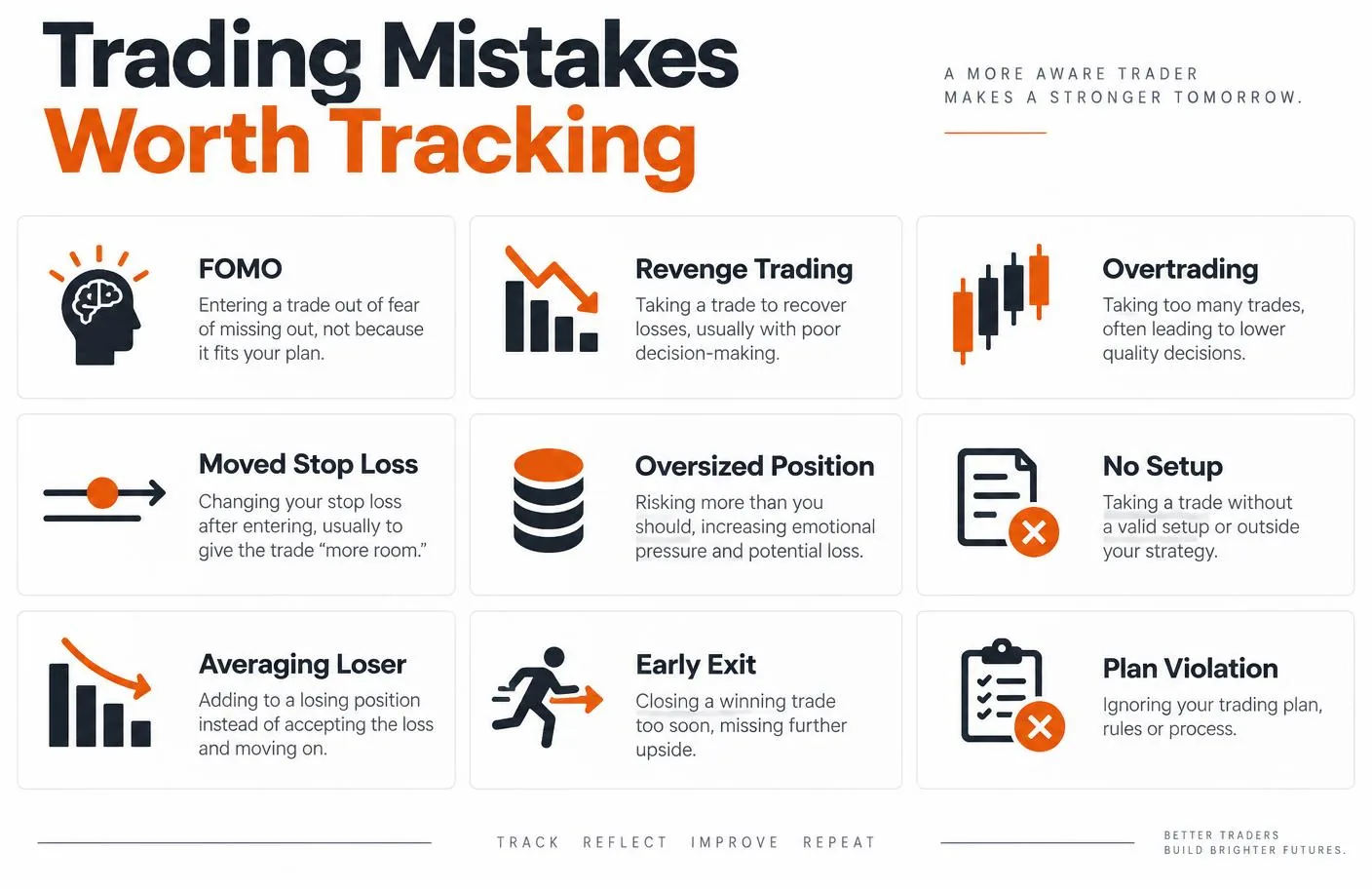
1. FOMO Trading
FOMO usually appears when a trader sees price moving without them. You planned to enter at one level. Price moves. Instead of waiting for another valid opportunity, you enter because you do not want to watch the move continue without you.
The problem is not simply entering late. FOMO can also change entry quality, stop distance, risk-to-reward, position size and decision speed.
Example entry
- Mistake
- FOMO
- Trigger
- Saw a strong candle after missing planned entry.
- Action
- Entered immediately.
- Result
- Late entry with poor stop location.
- Better rule
- If the planned entry is missed, wait for another valid setup.
2. Revenge Trading
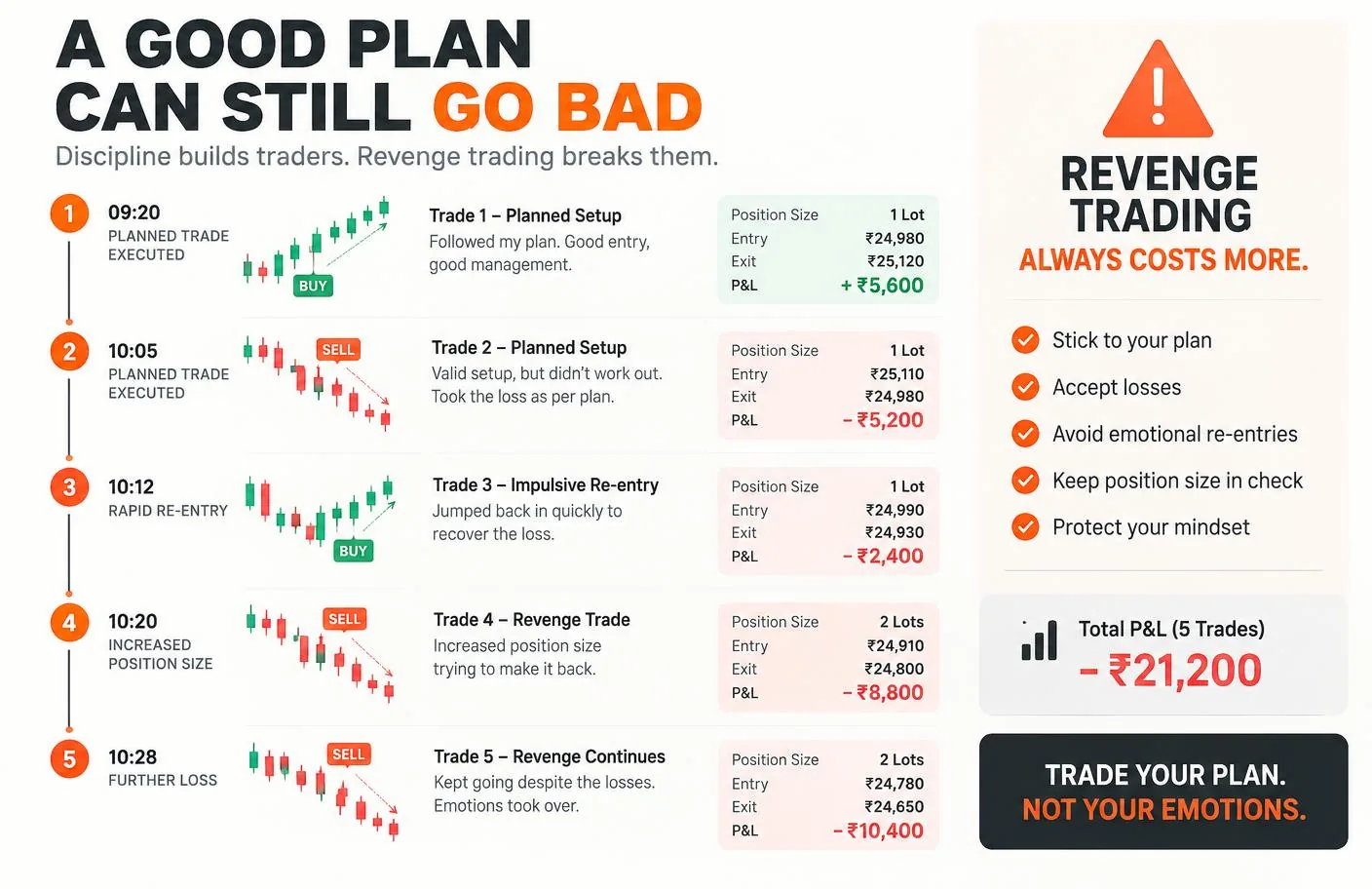
Revenge trading often starts after a loss. The trader is not necessarily thinking “I am revenge trading.” The thought usually feels more reasonable: “I can make that loss back.” “One more good setup.” “The market should reverse.” “I can't finish today negative.”
What matters is whether the reason for taking the next trade has changed. The guide on how to stop revenge trading covers the warning signs in more detail.
10:05 AM
Trade 1 · Planned setup
+₹1,200
10:48 AM
Trade 2 · Planned setup
-₹2,400
10:54 AM
Trade 3 · Entered six minutes later, no clear setup
-₹1,800
11:03 AM
Trade 4 · Quantity increased
-₹3,200
11:16 AM
Trade 5 · Another immediate trade
Daily loss increases
Illustrative example only.
Looking at the final P&L hides that behavioural sequence. A journal makes the sequence visible.
3. Overtrading
Overtrading is not simply taking many trades. A scalper may legitimately take more trades than a swing trader. The relevant question is whether you continue trading when the quality of your decisions has deteriorated. This is where trade-number analysis helps.
Sample data — for explanation only
This does not prove that every trader should stop after three trades. It tells this hypothetical trader that later trades deserve investigation — reduced selectivity, frustration, fatigue, boredom, revenge behaviour or forced setups.
The journal creates the question. Your review determines the answer.
4. Moving Your Stop-Loss
Your planned stop tells you where the trade no longer matches your original idea. A common mistake happens when that level is changed simply because the trader does not want to accept the loss: original stop ₹125, then ₹118 as price approaches, then ₹110. The risk has changed. The trading idea may not have.
Fields worth recording
- Planned stop
- Where the idea is invalid
- Actual stop
- Where you actually exited
- Why was the stop changed?
- Planned adjustment or emotional decision
After several weeks you can measure how often you changed your stop, whether those changes were planned or emotional, and what happened to trades where the original stop was violated.
Some strategies legitimately use trailing stops or predefined adjustments. The mistake is an unplanned change that violates your own strategy.
5. Oversized Positions
Suppose your normal quantity is 100. After two losses, you trade 250. If the next trade wins, the larger size may look like a smart decision. The question is whether 250 was part of your original risk plan. This is why position sizing should be tracked separately from P&L.
| Trade | Planned qty | Actual qty | Difference | Mistake |
|---|---|---|---|---|
| Trade 1 | 100 | 100 | 0 | No |
| Trade 2 | 100 | 100 | 0 | No |
| Trade 3 | 100 | 200 | +100 | Size violation |
| Trade 4 | 100 | 250 | +150 | Size violation |
Recorded this way, size escalation is easy to identify.
Position-size changes after a winning streak
Mistakes do not only happen after losses. Confidence changes behaviour too. After several winners you may increase size, take weaker setups or trade more often. Record your normal size, actual size, the previous three-trade result and your emotional state, and tag it OVERCONFIDENCE.
6. Averaging a Losing Position
Adding to a trade is not automatically a mistake. Some strategies include planned scaling. The distinction is whether the additional position was defined before the trade or added because you hoped to recover faster.
PLANNED SCALE-IN
- Entry levels decided beforehand
- Total risk calculated
- Maximum exposure known
- Action matches trading plan
UNPLANNED AVERAGING
- Position moves against you
- Quantity added emotionally
- Total risk increases unexpectedly
- No predetermined level
7. Taking Trades Without a Setup
This is one of the easiest mistakes to track. Ask one question of every trade: “What setup was this?”
“No Setup” should be a valid option. Do not force yourself to invent a reason after the trade. If you cannot explain why you entered, record that honestly. Over time, comparing trades with a defined setup against trades without one can be more useful than adding another indicator to your chart.
8. Entry and Exit Timing Mistakes
Late entries
A late entry often begins with hesitation or FOMO. Your original setup may have been valid, but after the move starts, the trade changes. Record the planned entry zone, the actual entry, the reason for the delay and the emotion — then review whether late entries consistently change stop distance, risk-to-reward, trade management and emotional pressure.
Entering too early
The opposite also happens. You see a setup developing and enter before your own confirmation rule because you expect the signal to appear. Sometimes it works. The important question is whether early entry is part of the plan. Tag it EARLY ENTRY and track planned confirmation, actual entry reason and outcome — not just profit or loss.
Exiting winners too early
Some traders take profits quickly because watching an open gain disappear feels uncomfortable. This can create a pattern where losing trades reach their planned stops while winning trades are constantly cut short. Record the planned target, actual exit, reason for exit, whether the trade was invalidated, and the emotion at exit.
Holding losing trades too long
A trader may know the planned exit level but hesitate when price reaches it: “It may come back.” “I'll give it a little more room.” “I don't want to book the loss.” Recording planned loss, actual loss, the difference and the reason for holding lets you measure the effect of rule violations instead of relying on memory.
Trading from boredom
Not every trade starts with fear or greed. Sometimes traders simply want something to happen during a slow session. Add one question to your journal: “Would I still take this trade if I had not been watching the screen for the last two hours?” Tag it BOREDOM TRADE.
Ignoring the trading plan
Use PLAN VIOLATION when the specific error is “I knew my rule, but I deliberately did something else” — trading outside planned hours, taking a setup you previously excluded, exceeding your maximum daily loss or trade limit. Wherever possible, add the specific mistake tag as well, such as PLAN VIOLATION plus OVERTRADING.
Not reviewing your trades
A journal that is never reviewed becomes a storage system rather than a feedback system. You do not need to analyse every metric every night, but periodically ask which mistake occurred most often, which had the largest financial effect, what triggered it, what rule would have prevented it, whether that rule is realistic, and whether frequency improved.
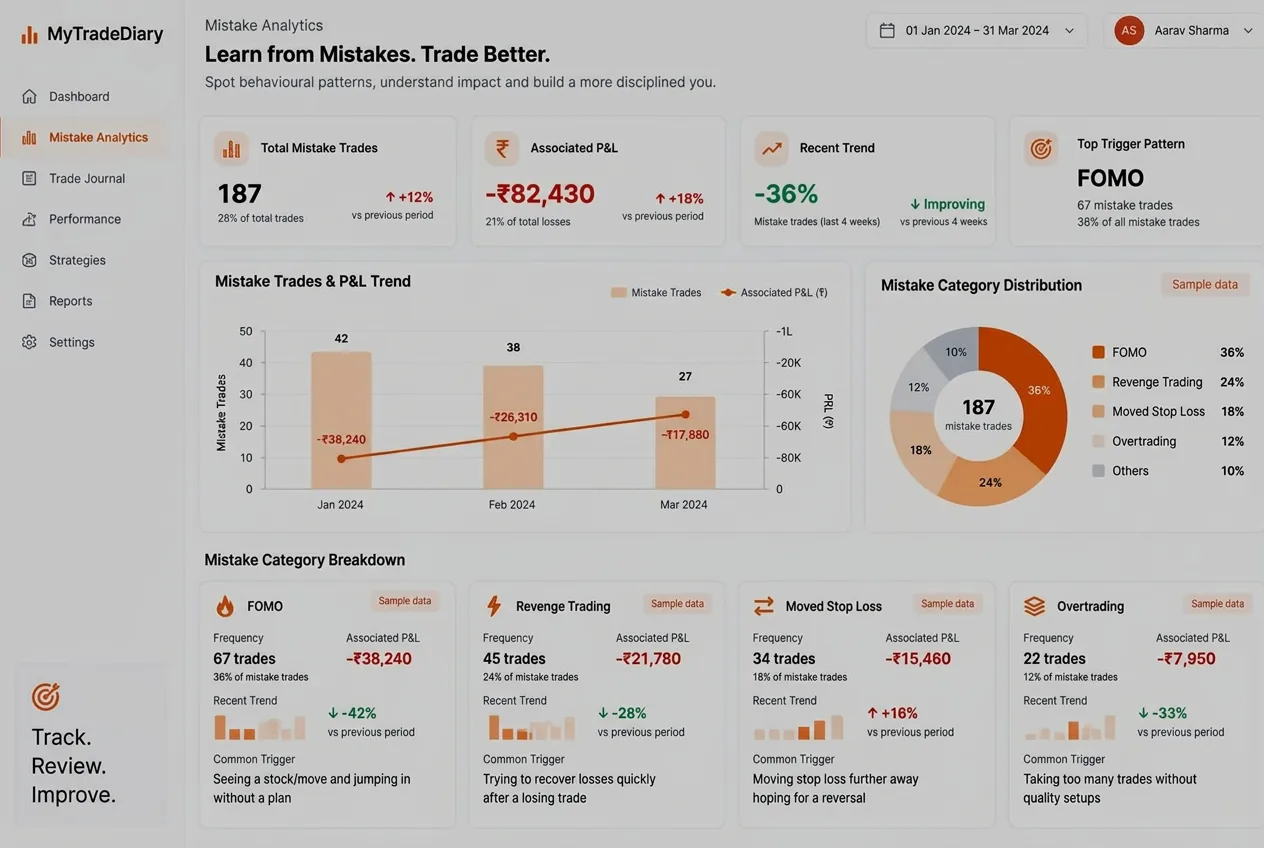
Track the Cost of Each Trading Mistake
Frequency alone does not tell the whole story. Imagine FOMO appearing 18 times with -₹8,000 associated P&L, while Moved Stop appears only 4 times with -₹21,000 associated. Which deserves more attention? Probably not the one occurring most often.
Frequency
How often does the mistake happen?
Financial impact
What P&L is associated with those trades?
Recency
Is the behaviour improving or getting worse?
Clustering
Does it happen after particular triggers?
Track What Triggered the Mistake
A mistake is useful to identify. A trigger is even more useful. Suppose you repeatedly tag REVENGE TRADE. Ask what happened immediately before it.
- A large loss
- Two consecutive losses
- A missed trade
- An early exit followed by continued movement
- A winning streak
- Boredom
- A social media tip
- Seeing another trader's profit
- Approaching market close
- Daily P&L target not reached
Journal structure
- Mistake
- Revenge trade
- Trigger
- Two consecutive losses
- Emotion
- Frustrated
- Action
- Immediate re-entry
- Lesson
- Take a mandatory review break after two consecutive losses.
That structure is far more useful than writing “Need discipline.”
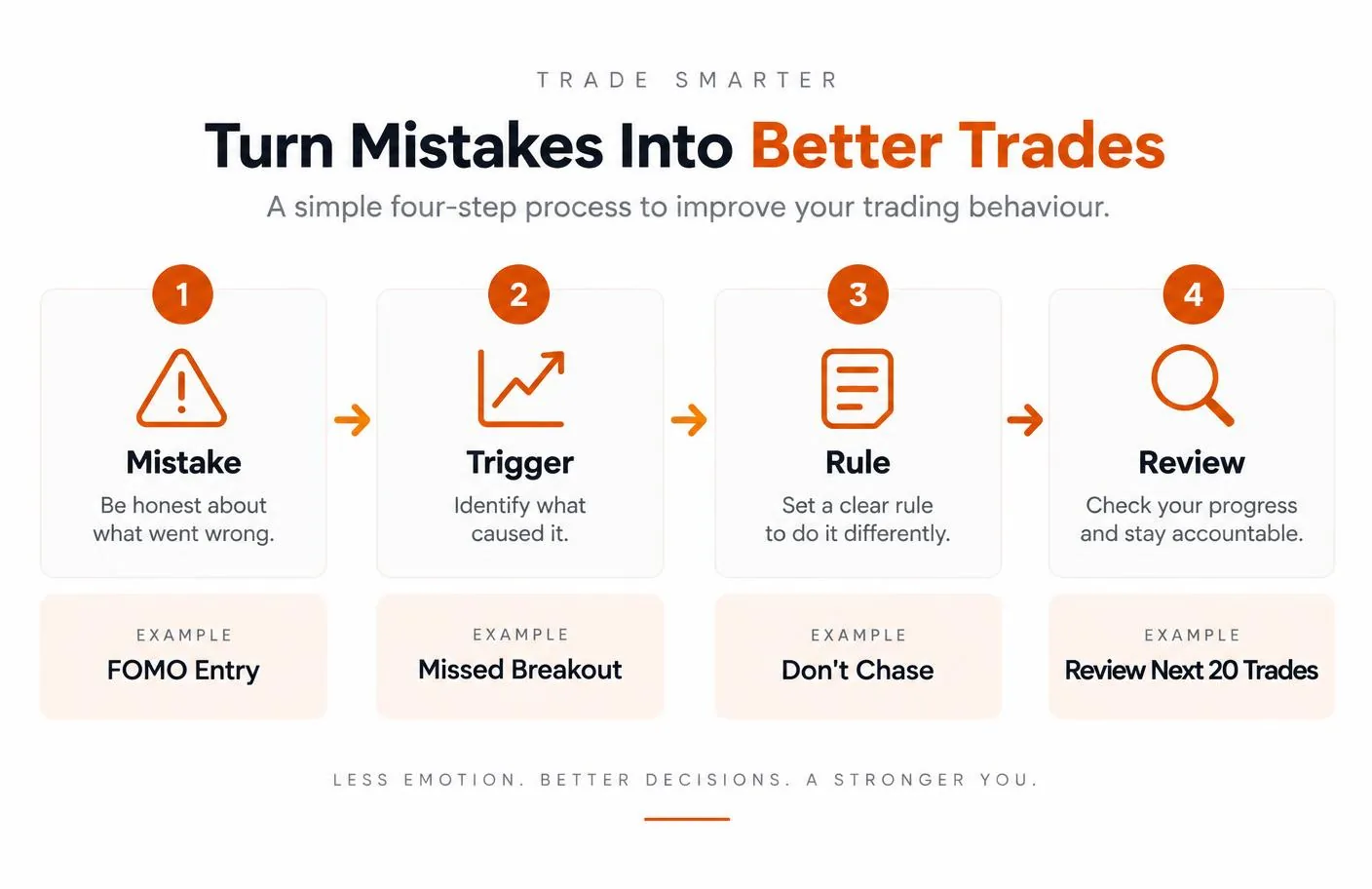
Create a Mistake → Trigger → Rule → Review System
1. Mistake
What did you do?
Example: FOMO entry
2. Trigger
What caused the behaviour?
Example: Missed initial breakout
3. Rule
What specific rule prevents repetition?
Example: Do not chase after price leaves the planned entry zone
4. Review
Did the mistake occur again?
Example: Compare next 20 trades
Avoid vague improvement goals. Instead of “I need better discipline,” write: “If I miss my planned breakout entry, I will not enter unless a new setup forms.” Specific rules can actually be reviewed later.
Your Daily Trading Mistake Review
- Did I follow my planned setups?
- Did I take any FOMO trades?
- Did I revenge trade after a loss?
- Did I exceed my planned number of trades?
- Did I change any stop emotionally?
- Did I change my position size unexpectedly?
- Did I average a losing trade?
- Did I exit a winner because of fear?
- Which trade was best executed?
- Which trade was worst executed?
- What mistake appeared today?
- What triggered it?
- What should I do differently next time?
Keep this review short. A review you complete consistently is more valuable than an elaborate process you abandon after three days.
Your Weekly Mistake Review
Daily reviews capture individual events. Weekly reviews show repetition.
Weekly summary — illustrative example only
Most common mistake
FOMO
Occurrences
4
Most expensive mistake
Moved Stop
Associated P&L
-₹4,800
Most common trigger
Loss on previous trade
Plan adherence
76%
- Which mistake occurred most often?
- Which mistake had the largest effect?
- Which trigger appeared repeatedly?
- Did mistake frequency improve from last week?
- Was there a particular time of day when mistakes increased?
- Did mistake frequency rise after losses?
- Which single behaviour should I focus on next week?
Don't Try to Fix 15 Mistakes at Once
Suppose your journal identifies FOMO, revenge trading, overtrading, stop movement, early exits and oversizing. Trying to eliminate all six immediately makes the review process unnecessarily complicated. Choose one behaviour instead.
Focus this week
- Behaviour
- Revenge trading
- Rule
- After two consecutive losses, no new position for 20 minutes.
- Review
- Check all trades next Sunday.
Then evaluate: did the rule help, was it realistic, did you follow it, does it need modification? That creates a much clearer improvement loop.
Trading Mistake Tracker vs a Normal P&L Dashboard
| P&L dashboard | Mistake tracker |
|---|---|
| Total profit / loss | Why decisions were made |
| Winning trades | Rule adherence |
| Losing trades | Repeated mistakes |
| Daily result | Emotional triggers |
| Win rate | Behaviour patterns |
| Drawdown | Mistake frequency |
| Performance curve | Mistake-associated P&L |
| Historical returns | Lessons and rules |
Both are useful. A mistake tracker does not replace performance analytics; it adds behavioural context. If you are still building the basics, start with our trading journal guide for Indian traders, or the specialised guide to an options trading journal.
How MyTradeDiary Helps You Track Trading Mistakes
Mistake tracking is one of the reasons MyTradeDiary was built. Traditional trading records usually focus on entry, exit, quantity and P&L. Those numbers matter, but they do not tell you why the trade happened.
Mistake Tagging
Tag recurring errors such as FOMO, revenge trading or overtrading.
Emotion Tracking
Record your emotional state around trading decisions.
Setup Tracking
Separate strategy performance from behavioural mistakes.
Daily Notes
Record what happened during the session.
Performance Review
Review historical patterns rather than relying on memory.
AI Summary
Use your journal history to summarize areas worth reviewing.
MyTradeDiary is a journaling and analytics tool. AI-assisted summaries organize your own journal history; they do not predict markets, guarantee discipline or prevent losses.
Stop Guessing Which Mistakes You Repeat
Keep your trades, setups, mistakes, emotions and reviews together so you can see patterns in your actual trading behaviour.
How to Start Tracking Your Trading Mistakes Today
Start with your next trade. You do not need twenty categories. Begin with five.
After each trade, ask whether any of these happened. If yes, tag it and write one sentence explaining what triggered it. At the end of the week, review the tags, then add new categories only when they become relevant to your trading.
The goal is not a perfect journal. The goal is to make repeated behaviour easier to see.
Trading Mistake Tracker FAQ
What is a trading mistake tracker?
A trading mistake tracker is a system for recording repeated behaviours that occur around trades, such as FOMO entries, revenge trading, overtrading, moving stop-losses or breaking position-size rules. It is usually used as part of a trading journal.
What trading mistakes should I track?
Useful categories can include FOMO, revenge trading, overtrading, late entries, early entries, moving stop-losses, oversized positions, averaging losing trades, exiting winners too early and entering without a defined setup. The most useful categories depend on your own trading plan.
Is every losing trade a mistake?
No. A trade can follow your plan correctly and still lose. A trading mistake usually refers to a decision or behaviour that violates your predefined process or rules.
Can a profitable trade still be a bad trade?
From a process perspective, yes. A trade may make money even if you entered without a setup, ignored risk rules or took an oversized position. Journaling both outcome and execution quality helps separate luck from process.
How do I track FOMO trades?
Tag the trade as FOMO and record what triggered the entry, such as missing an earlier move or seeing price accelerate. It can also help to record your planned entry versus your actual entry.
How can I track revenge trading?
Record trades taken shortly after a loss and note whether the next trade followed a valid setup. Tracking consecutive losses, time between trades, position-size changes and emotional state can help reveal revenge-trading patterns.
What is overtrading?
Overtrading occurs when a trader continues taking trades beyond their planned process, or when the quality of decisions deteriorates while trade frequency keeps rising. The number itself matters less than whether selectivity has dropped.
How many mistake categories should I use?
Start with about five that clearly apply to your trading, such as FOMO, revenge trade, overtrading, moved stop and no setup. Add new categories only when a behaviour becomes relevant enough to review.
Should I track the trigger as well as the mistake?
Recording the trigger is often more useful than the tag alone. Knowing that a revenge trade followed two consecutive losses gives you something specific to build a rule around.
Can a mistake tracker guarantee better results?
No. A mistake tracker cannot prevent losses or guarantee profitability. It is a review tool that helps you see which behaviours repeat so you can decide what to work on.