Revenge Trading: What It Is, How to Recognize It & How to Track It
MyTradeDiary Editorial Team · Published 18 September 2026 · Updated 18 September 2026 · 12–14 min read
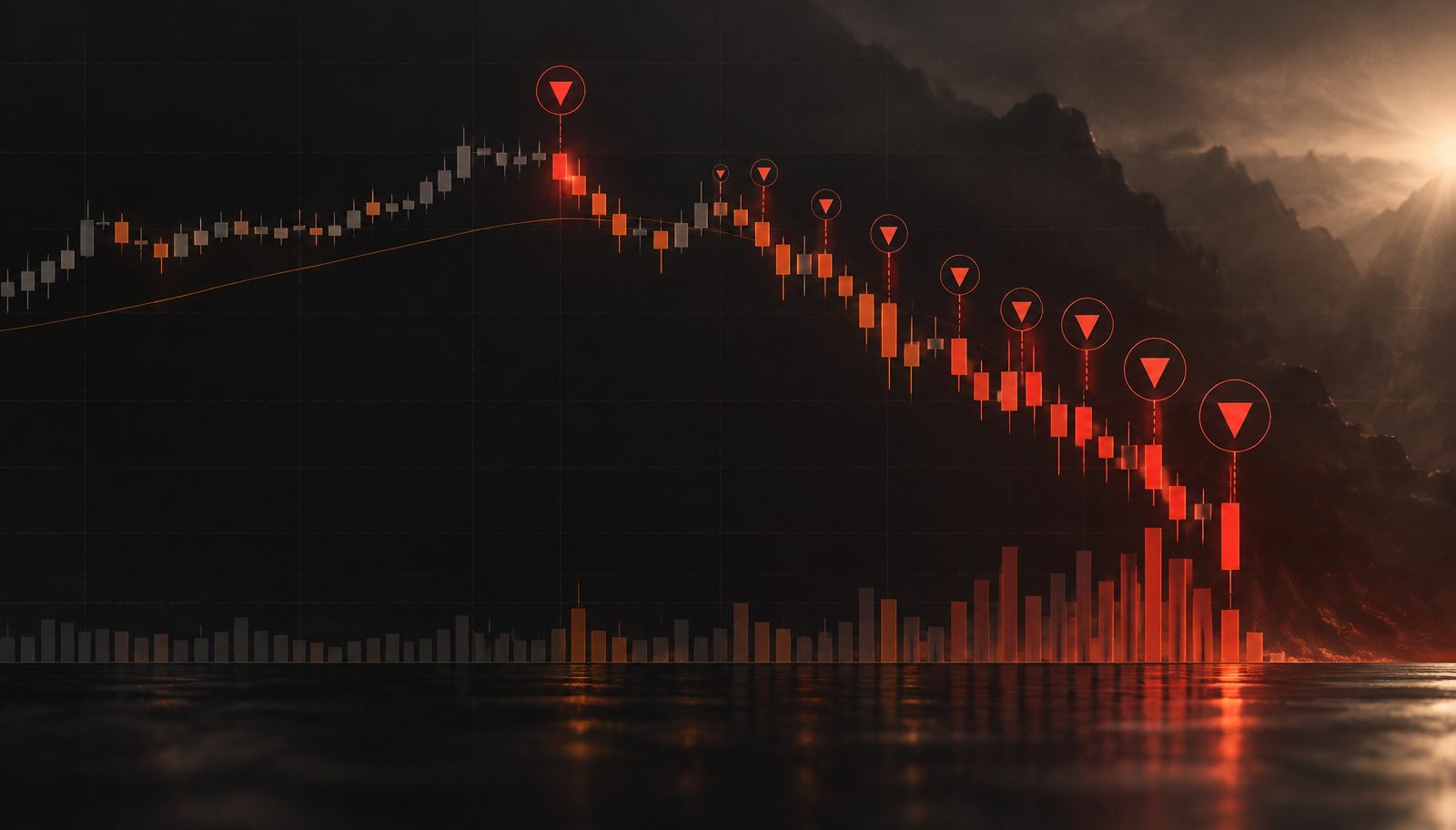
You take a valid trade with risk inside your plan. The market moves against you and your stop-loss is hit. Loss: ₹2,500. Nothing unusual so far—losing trades are part of trading.
Six minutes later, you enter again. The setup is less clear. That trade also loses. Now the thought appears: “I just need one good trade to recover this.” Your next position is larger, your entry is faster and you give the trade more room than usual.
The first loss may have been completely normal. What happened afterwards was different. That pattern is commonly called revenge trading.
A trading journal can make that difference visible.
In this guide
- What Is Revenge Trading?
- Another Trade Is Not Automatically Revenge
- How It Starts
- The Revenge Trading Loop
- 7 Warning Signs
- Rapid Re-Entry
- Position Size Changes
- Setup Quality
- Stop-Loss Behaviour
- Trade Frequency
- Revenge Trading in Options
- P&L Can Hide the Pattern
- How to Track It
- Track the Trigger
- Calculate the Impact
- Post-Loss Review
- Personal Rules
- Weekly Review
- MyTradeDiary
- FAQ
What Is Revenge Trading?
Revenge trading is when a recent result—usually a loss—begins influencing the next decision more than the trader's normal setup or process. The urge may be to recover the loss, finish green, prove the original view correct or quickly undo what happened.
The next trade may even make money. That does not automatically make the process good. A useful review separates outcome from process.
Taking Another Trade After a Loss Is Not Automatically Revenge Trading
A strategy may regularly produce several valid setups in one session. If the next setup is valid and you use your normal entry, size, stop and risk rules, the previous loss does not automatically make it a revenge trade.
NORMAL NEXT TRADE
- Previous trade
- Loss
- New setup
- Valid
- Position size
- Normal
- Risk
- Within plan
- Reason
- Setup appeared
POSSIBLE REVENGE TRADE
- Previous trade
- Loss
- New setup
- Weak / unclear
- Position size
- Increased
- Timing
- Immediate
- Reason
- Recover previous loss
The previous loss is not enough to identify the pattern. You need context.
How Revenge Trading Often Starts
It can begin with a completely normal stop-out. The important transition is “I am waiting for my setup” becoming “I need another trade.” The emotional response differs: anger for one trader, regret for another, or simply discomfort with finishing negative.
Normal loss
→Emotional response
→Urgency
→Process changes
Track what actually happens in your own trading rather than assuming everyone experiences the same sequence.
The Revenge Trading Loop
Loss
A normal or avoidable losing trade.
→Recover it
The result becomes the focus.
→Quicker entry
Waiting becomes uncomfortable.
→Weaker process
Size, setup or risk changes.
Once inside the loop, each result can influence the next decision. Instead of asking “Is this trade valid?”, the question becomes “Can this trade repair my P&L?” A journal helps locate the point where that change occurred.
7 Warning Signs of Revenge Trading
1. Very quick re-entry
Your normal 35-minute gap becomes four minutes after a loss.
2. Position size increases
Quantity moves from 100 to 200 without a planned setup rule.
3. Setup is hard to explain
You cannot clearly name what made the next trade valid.
4. Recovery becomes the objective
The thought changes from criteria to getting the money back.
5. Stop behaviour changes
Accepting another loss feels harder, so the normal stop moves.
6. Trade frequency rises
Doing nothing feels uncomfortable and opportunities appear everywhere.
7. Normal limits disappear
You trade past planned hours, trade count or daily loss limits.
One sign by itself does not prove revenge trading. Look for combinations and repeated patterns.
The Time Between Trades Can Reveal a Lot
One useful journal metric is time to next trade. The chart below is illustrative data only; it creates a question rather than proving intent.
TIME TO NEXT TRADE · ILLUSTRATIVE DATA ONLY
Why does decision speed change after a loss? That is the useful review question.
Track Position Size After Losses
Revenge trading can appear through position sizing rather than frequency. Compare planned and actual quantity—not only final P&L.
| Trade | Result before entry | Planned qty | Actual qty | Change |
|---|---|---|---|---|
| 1 | — | 100 | 100 | Normal |
| 2 | Previous loss | 100 | 100 | Normal |
| 3 | Two losses | 100 | 200 | +100 |
| 4 | Further loss | 100 | 250 | +150 |
Example only.
Setup Quality Often Changes Before P&L Does
If your plan recognizes Breakout, Pullback and Support Bounce, but post-loss notes begin saying “Maybe Reversal” or “No Setup”, selectivity may have declined.
SETUP QUALITY · EXAMPLE FRAMEWORK
- A
- Fully matches plan
- B
- Mostly matches
- C
- Weak / discretionary
- No setup
- No predefined criteria
This is not a universal scoring system. Use categories that match your own process.
Your Stop-Loss Behaviour May Change After a Loss
Suppose the planned stop is ₹130, but the actual exit is ₹118 because “I didn't want another stop-out.” That sentence is useful journal data.
- Planned stop
- ₹130
- Actual exit
- ₹118
- Stop modified?
- Yes
- Previous result
- Loss
- Emotion
- Frustrated
- Reason
- Avoid another stop-out
Review whether stop violations appear more frequently after losing trades.
Revenge Trading Can Look Like Overtrading
| Revenge trading | Overtrading |
|---|---|
| Triggered by a recent result | Can occur without a prior loss |
| Goal may become recovering money | May come from boredom, FOMO or activity |
| Often appears rapidly after loss | Can develop through the session |
| Size may increase | Size may remain normal |
| Setup standards may decline | Setup standards may also decline |
Tag both when appropriate. The Trading Mistake Tracker guide explains how to review overlapping behaviours.
What Revenge Trading Can Look Like in Options
- Immediate re-entry into another CE or PE
- Switching direction repeatedly
- Choosing another strike because the premium appears easier to recover with
- Increasing lots
- Buying after a rapid premium move
- Repeated entries after stop-outs
NIFTY OPTIONS · ILLUSTRATIVE EXAMPLE
- First trade
- NIFTY 25000 CE
- Result
- -₹2,400
- Six minutes later
- NIFTY 24950 CE
- Quantity
- Increased
- Setup
- Unclear
- Reason
- Wanted to recover previous trade
The important information is not that both were calls. It is that the second decision was influenced by the first loss. See the Options Trading Journal India guide for contract-level fields.
Your Daily P&L Can Hide Revenge Trading
Two traders can both finish at -₹8,000 while showing completely different behaviour.
DAY A · ONE PLANNED LOSS
-₹8,000
Valid setup. Normal risk. Stopped afterwards.
DAY B · LOSS + REVENGE SEQUENCE
-₹8,000
Four losses. Trades 2–4 happened rapidly after the first.
Same result. Different process. Daily P&L alone cannot show that difference; trade history can.
How to Track Revenge Trading in Your Journal
A revenge trading journal should reconstruct the sequence around the trade.
REVENGE-TRADE JOURNAL TEMPLATE
- Previous trade result
- -₹2,500
- Time since previous trade
- 6 minutes
- Current setup
- Unclear breakout
- Setup quality
- C
- Planned quantity
- 100
- Actual quantity
- 200
- Emotion
- Frustrated
- Main reason
- Wanted to recover loss
- Plan followed
- No
- Tag
- REVENGE TRADE
- Lesson
- Previous loss changed my entry criteria
- Post-trade note
- Complete after the session
Track the Trigger, Not Just the Revenge Trade
The tag is useful, but a better journal asks what triggered it: a normal stop, consecutive losses, a missed opportunity, an immediate reversal after your stop, an early exit, a failed breakout, the previous day's loss or the desire to finish profitable.
Trigger
Stop-loss
→Emotion
Frustration
→Thought
I need to get it back
→Behaviour
Immediate re-entry
A trading psychology journal adds this context without assuming the same trigger applies to everyone.
Measure the Cost—But Interpret It Carefully
Once trades are tagged, review their associated results. Avoid claiming one emotional factor directly caused the entire amount.
SAMPLE DATA ONLY
Revenge trades
11
Associated P&L
-₹14,700
Average re-entry
7 min
Size violations
6
Plan violations
9
A careful conclusion is: “Trades I tagged as revenge trades were associated with -₹14,700 during this period.” Other variables may also be involved.
The Five-Minute Post-Loss Review
This is a journaling framework, not a universal trading rule.
POST-LOSS CHECK
- Did the previous trade follow my plan?
- What am I feeling right now?
- Am I searching for a trade because I lost?
- Would I take this setup if the previous trade had won?
- Am I using my normal position size?
- Does this setup fully match my criteria?
- What would make this trade invalid?
The objective is to create separation between the previous outcome and the next decision.
Create a Personal Post-Loss Rule
“Don't revenge trade” is difficult to review. A measurable personal rule is clearer.
| Vague | Measurable example |
|---|---|
| Don't revenge trade | After two consecutive losses, I will complete my post-loss review before entering again. |
| Stay disciplined | If the next trade does not match a predefined setup, I will tag it NO SETUP and skip it. |
| Don't increase size | My size does not change based on whether the previous trade won or lost. |
These are examples of how to write reviewable rules, not thresholds every trader should adopt.
Loss
Previous result
→Pause
Create separation
→Review
Emotion, setup and size
→Decide
Evaluate independently
The framework does not guarantee the next trade wins. It makes the next decision more deliberate.
What to Review at the End of the Trading Day
- Did any loss change how quickly I entered again?
- Did position size increase?
- Did I take a trade without a clear setup?
- Did I think about recovering money?
- Did I move a stop because I did not want another loss?
- Did trade frequency increase?
- Which trade first showed a change?
- What trigger appeared?
- What would I do differently if the sequence appeared again?
The objective is not self-criticism. It is to reconstruct what happened accurately.
Your Weekly Revenge Trading Review
ILLUSTRATIVE EXAMPLE ONLY
- Most common trigger
- Consecutive losses
- Revenge trades
- 4
- Average re-entry time
- 8 min
- Size violations
- 2
- No-setup trades
- 3
- Plan adherence
- 78%
- What happened immediately before tagged trades?
- How quickly did I re-enter?
- Did position size change?
- Were the setups valid?
- Which day showed the clearest pattern?
- What one personal rule should I review next week?
Revenge Trading vs FOMO
| Revenge trading | FOMO |
|---|---|
| Usually follows a recent result | Often follows a missed opportunity |
| Focus may be recovering a loss | Focus may be avoiding a missed move |
| Can involve rapid re-entry | Can involve chasing |
| Size may increase | Entry price may become worse |
| Trigger often relates to P&L | Trigger often relates to price moving without you |
They can overlap. Your journal can apply more than one tag when appropriate.
Revenge Trading vs Normal Persistence
Some strategies legitimately allow multiple entries, re-entries or scale-ins. The useful question is whether those actions were defined beforehand.
PLANNED RE-ENTRY
- Rule existed before the trade
- Position size predetermined
- Criteria unchanged
- Risk defined
EMOTIONAL RE-ENTRY
- Created after the loss
- Position size changes
- Criteria become weaker
- Goal becomes recovery
How MyTradeDiary Helps You Track Revenge Trading
Revenge trading is difficult to understand from a broker P&L statement alone. The important information often sits between trades: the wait, previous result, emotion, setup quality, size change and plan adherence.
Revenge trade tagging
Mark trades that may have been influenced by a previous loss.
Mistake tracking
Track revenge alongside FOMO and overtrading.
Emotion tracking
Record frustration, fear or other relevant states.
Setup tracking
Review whether post-loss trades matched your process.
Daily notes
Record what changed during the session.
Performance review
Review patterns across historical trades.
AI journal summary
Summarise recurring themes from your own journal for easier review.
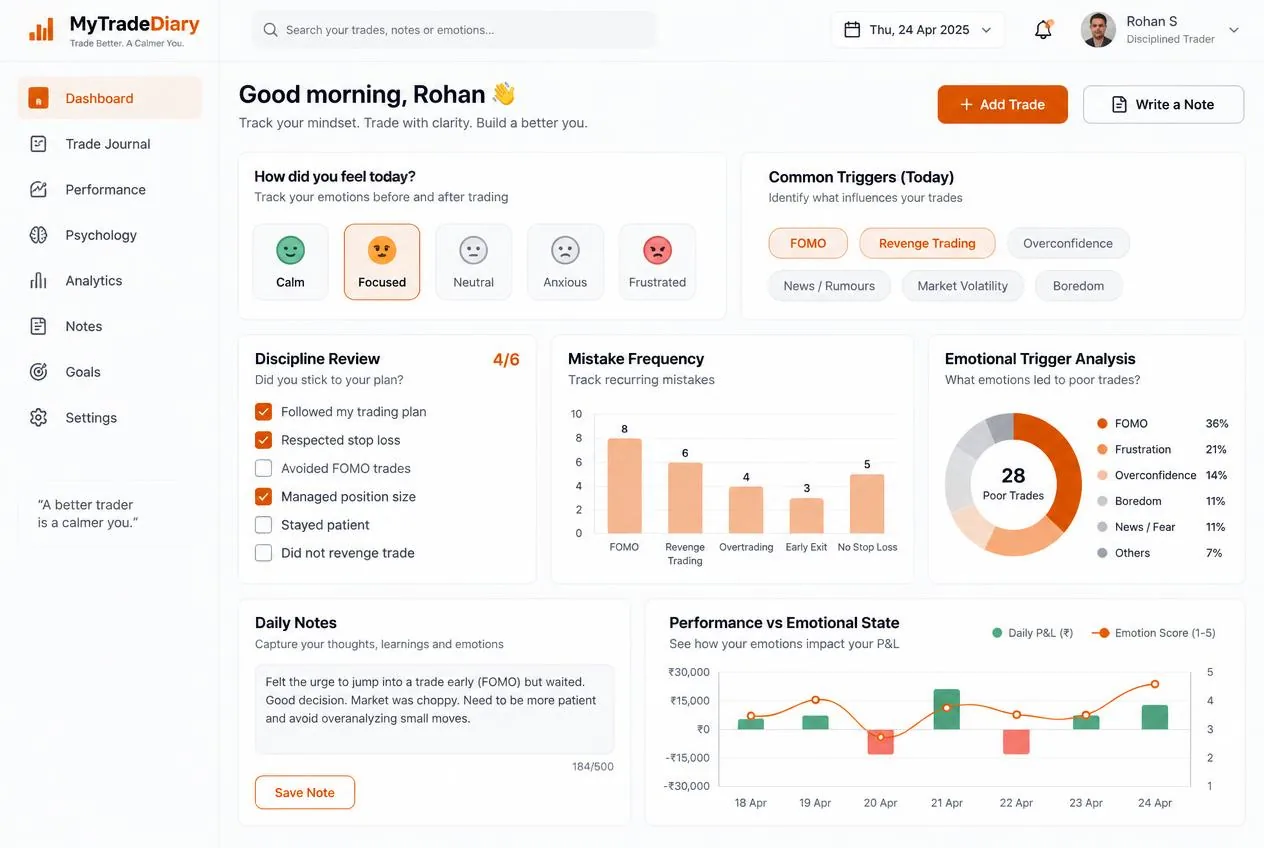
See What Happens After the Loss
Track trades, setups, mistakes and emotions together so you can review how one trade influences the next.
How to Start Tracking Revenge Trading Today
For your next twenty trades, add four fields: previous result, time since previous trade, emotion and whether the trade fully matched your setup. If it feels primarily intended to recover the last loss, add the tag REVENGE TRADE and one sentence explaining why.
Then review the sequence. Do you enter faster after losses? Does size change? Do setup standards decline? Do you trade longer? Your own journal gives you something concrete to examine.
Revenge Trading FAQ
What is revenge trading?
Revenge trading generally refers to taking a trade primarily because of an emotional reaction to a previous result, commonly a loss, rather than because the new trade independently meets the trader's normal setup and risk rules.
Is every trade after a loss a revenge trade?
No. Traders can legitimately take another valid setup after a losing trade. The useful question is whether the previous loss changed the reason for entering, setup quality, position size, risk or execution.
What are common signs of revenge trading?
Possible signs include unusually quick re-entry, increased position size, weaker setup quality, thinking about recovering money, moving stop-losses, increased trade frequency and continuing beyond normal limits.
Why do traders revenge trade?
The exact reason varies. Triggers can include frustration, regret, the desire to recover money quickly, discomfort with ending the day negative or a strong reaction to a stop-out.
How can I identify revenge trading in my journal?
Track the previous result, time between trades, setup quality, planned versus actual position size, emotion, reason for entry and whether the new trade followed your normal plan.
Can revenge trading happen after a profitable trade?
The term is most commonly associated with losses. Behaviour can also change after profits—for example, overconfidence after a large winner—but that may be more useful to tag separately.
What is the difference between revenge trading and overtrading?
Revenge trading is usually connected to a previous result and a desire to react to it. Overtrading is broader and can happen because of boredom, FOMO, frustration or other reasons.
What is the difference between revenge trading and FOMO?
Revenge trading is often triggered by a previous result. FOMO is more commonly triggered by fear of missing a market move. Both can occur together.
Can revenge trading happen in options?
Yes. It may appear as rapid re-entry after a stop, changing strikes or direction, increasing lots, chasing premiums or taking lower-quality setups.
Can a trading journal stop revenge trading?
A journal cannot guarantee that a trader will stop revenge trading. It can make post-loss behaviour easier to identify by recording triggers, emotions, timing, size changes and rule violations.
Should I stop trading after every loss?
There is no universal rule requiring every trader to stop after every loss. Strategies differ. Journaling helps determine whether losses consistently change your own decision-making.
Can revenge trading cause losses?
Any trade can lose. Revenge trading may be associated with weaker setup selection, increased exposure or rule violations, but a journal should not assume that one emotional factor caused every result.